Table of Contents
March 2026 – Conserving the Sacred
- Letter From the Editor — Conserving the Sacred: From a north-facing window over tribal lands and a house rattled by winter wind, Noble reflects on Banff’s disappearing winter and calls us—exhausted good people everywhere—to realize, reach out, and recycle, because the sacred won’t conserve itself.
- Interlude I — A brief, luminous pause after the editor’s opening—an invocation of sacredness in the living world before we enter the hard essays.
- How the Cat Came Back— A lyrical, reported look at the Iberian lynx comeback—how long-term conservation rebuilt a future, and why that hard-won recovery is still fragile, still owed.
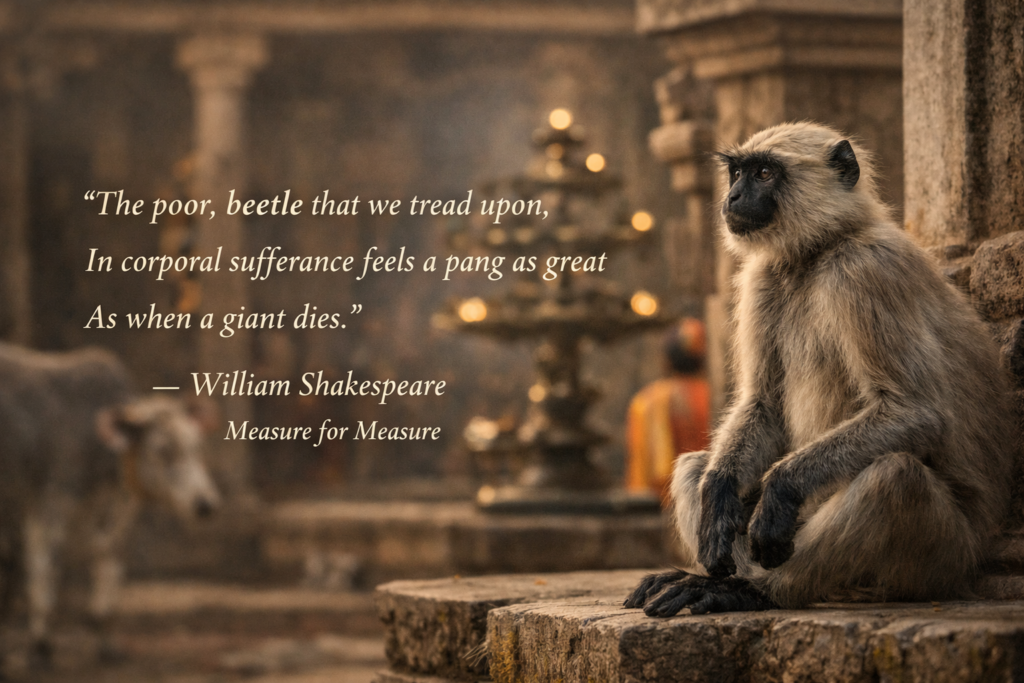
- Sacred Guests — A grounded look at temple “monkey society”—where reverence and conflict share the same stone steps, and shrinking forests push sacred guests ever closer to human life.
- Interlude II — The Creature Is Not Ours: A brief reminder that small lives carry full weight—and that reverence begins where our footsteps learn restraint.
- Great Apes, Great Pressure: Gorillas, Orangutans, Chimpanzees — A comparative field report on three great apes—three different pressures, one shared truth: conservation only works when we keep holding the line.
- Faultlines in Numbers, The Sacred Index — A visual ledger of nine stark measures—proof that “protected” is not the same as preserved, and that the sacred is being audited in real time.
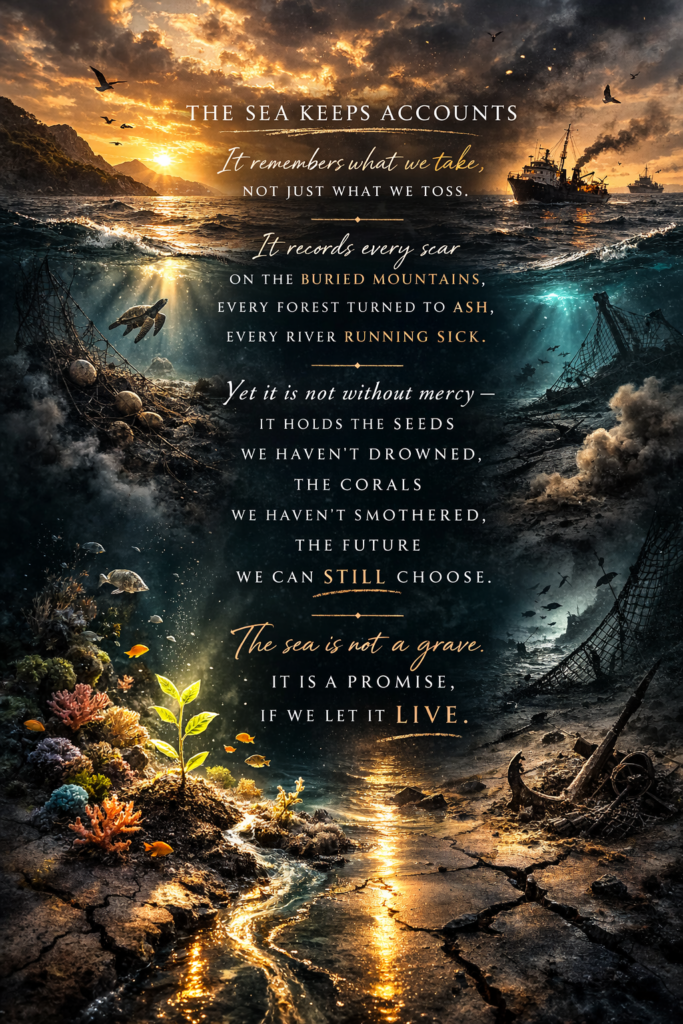
- Interlude III — The Sea Keeps Accounts — A brief lyric pause between the data and the deep—reminding us that the ocean remembers what we take, and waits for what we choose to repair.
- The Seafloor Is Not a Quarry — A visceral look at bottom trawling, “paper” marine protections, and what it means to defend the ocean as sacred ground—not a resource pit.
- West Africa’s Stolen Fish — A reported look at how industrial fleets, weak enforcement, and export-driven demand strip West African coasts of fish—turning food, livelihood, and “common waters” into contested ground.
- Holy Water, Hard Disease — A sacred river engineered for security becomes a corridor for disease—where infrastructure, ecology, and neglect collide, and repair becomes a moral duty.
- Interlude IV — The River Remembers: A breath between grief and resolve—an interlude that lets the Senegal River speak as witness, memory, and warning before we turn back to policy and power.
- The Sacred Sold Off — A clear-eyed look at how “management” becomes a euphemism for extraction—and what it costs when the last intact places are treated as inventory instead of inheritance.
- Through the Rainbow Lens — Queer Ecology: Chosen Kinship, Chosen Stewardship — A luminous LGBTQ-forward meditation on sanctuary—how chosen family, real protection, and daily stewardship can become a vow to the living world.
- Bye Land, Bye Sea, Bye Air — A sweeping anchor essay on the three-front assault—land, ocean, and atmosphere—and the sacred duty of drawing boundaries before “goodbye” becomes policy.
- Reflections in Verse — A closing vow for land, sea, air, and kin—where grief becomes guardianship, and spring asks us to begin again.
Letter From the Editor
Conserving the Sacred
I’m writing to you from my home office, where the window faces north and the long view opens out toward the tribal lands of Northwestern Arizona—an expanse that has held its ground through empires, through fashions, through the brief arrogance of human certainty. Today the last breath of winter is not gentle. It howls around the house and screams through the ash-catcher on the chimney, the kind of wind that reminds you a home is not a bunker so much as a small, brave agreement with weather.
There is one dog at my feet now. I’m still learning the new shape of the room, the way a life rearranges itself after loss. Grief has a quiet pressure to it; it changes what you notice. It makes you look harder at what remains. It makes you grateful and sharp in the same breath. And maybe that’s part of why this issue came together the way it did—tenderness and fury, equal measure, because that’s what love looks like when it’s grown up enough to tell the truth.
Two weeks ago, I was in Banff National Park in Alberta, Canada. I didn’t go there to “find a theme.” I went because sometimes the only sane response to the world is to stand in a place so beautiful it forces you to remember what’s worth defending. The Rocky Mountains don’t need my poetry, but they do something to the human spirit: they widen it. They make you feel small in a way that’s healing instead of humiliating. They remind you that the planet is not a stage built for us; we are guests here, and the rules were written long before we arrived.
At Lake Louise, in years past, there have been ice castles built in competition—winter’s small monuments, a communal act of wonder. But this time there were no ice castles. Not because people forgot how to build them, or because awe fell out of fashion. There wasn’t enough cold. In the middle of winter, in the frigid North, the season couldn’t quite hold. The absence was its own kind of headline—quiet, undeniable, almost polite. And that is how so much of climate grief arrives: not always with a catastrophe, but with a missing thing.
This issue is called Conserving the Sacred because I’m tired of pretending the natural world is merely “out there,” separate from the moral life. We talk about sacredness as though it belongs only to buildings and books, to ceremonies and beliefs. But sacredness is also a duty. It’s the act of treating what cannot speak for itself as if it matters anyway. It’s the refusal to calculate everything in dollars. It’s recognizing that land and water and wildlife are not props in our stories—they are the story, the older story, the one we depend on whether we admit it or not.
I know we live in a time when political fatigue is real. Exhaustion has become a weather system of its own. The news cycles grind. The arguments harden into tribal slogans. And it is tempting—so tempting—to retreat into private life and hope that someone else, somewhere else, will fix what’s breaking. That temptation is the villain of this letter. Not a party, not a person, not a debate. The most dangerous lie we tell ourselves is that responsibility belongs to “them.” That the repair will be done by strangers with more power, more money, more time, more certainty.
Meanwhile, the world keeps moving. Policy shifts. Protections erode. Short-term gains are celebrated while long-term losses are treated like unfortunate background noise. And yet: we still wake up in the same air. We drink the same water. We inherit the same consequences. New and old, faithful and faithless, American and not—exhausted good people all over the world—we are going to have to keep living here. And living together.
So I want this issue to do three simple things, the way a good lantern does: not flood the whole world with light, but make the next step visible.
First: Realize.
Not in a shaming way. Not in a doom-scrolling way. Realize as in: look straight at it. Notice what’s missing. Notice what’s changing. Notice what’s being harmed, and who is being asked to pay for that harm. Realize that conservation isn’t only about charismatic animals in faraway forests—it’s also about your local creek, your city trees, your community park, your watershed, your habits. Realize that “sacred” is not a compliment; it’s a claim. If something is sacred, it demands care.
Second: Reach out.
Not everyone can chain themselves to a tree. Not everyone can donate at a level that feels heroic. Most of us are ordinary, busy, tired people trying to be decent inside a system that rewards indifference. But community is where the sacred becomes practical. Reach out to a local group restoring habitat. Reach out to a neighbor who gardens and trade seeds instead of scrolling. Reach out to your library and ask what they’re hosting. Reach out to a school and offer to help a garden project. Reach out to a city council meeting when a patch of land is being treated like a blank space on a spreadsheet. Reach out because isolation is how people get convinced they don’t matter, and shared effort is how we remember we do.
Third: Recycle.
And I mean this in the broadest sense: recycle your materials, yes, but also recycle your attention and your hope. The small disciplines are not meaningless. They are training. Recycling is a daily refusal to participate in the myth of endlessness. It’s a way of saying: I will not treat the world as disposable. And when paired with other actions—reducing, repairing, reusing, supporting better policies, choosing less waste when you can—it becomes part of a culture shift. Not a perfect one. A real one.
I’m still committed to recycling. Still committed to travel—not as escape, but as witness. I want to see what good is left in the world while it is still here to be seen. I want to remember what places look like before they become “before” stories. And I’m more aware than ever of my own impact, which means I’m trying to get better at the quiet, unglamorous work: being extra attentive to my garden, learning how to become more self-sustaining, letting the seasons teach me patience again. A garden has a way of correcting you. You can’t bully a seed into sprouting. You can only prepare the ground, offer water, and keep showing up.
That’s what I want Conserving the Sacred to feel like: prepared ground. A place where the heavy essays are broken up by breath—interludes that remind us we’re human, not machines built to carry tragedy without rest. A place where we can hold the beauty of the world and the brutality done to it in the same hands without dropping either. A place where tenderness doesn’t become denial and fury doesn’t become paralysis.
If you’re reading this with a tired heart, I want you to know I’m not asking for perfection. I’m asking for participation. The sacred isn’t conserved by saints. It’s conserved by people who keep choosing care even when it’s inconvenient, even when it feels too small, even when no one applauds. The sacred is conserved by people who refuse to hand their responsibility to strangers.
Outside my window, the wind keeps working the world. The tribal lands in the distance remain—enduring, watchful, older than my worries. Somewhere, spring is gathering itself like a held breath. And somewhere else, a lake in the North is trying to remember winter. The world is still beautiful. That doesn’t absolve us. It recruits us.
Thank you for being here—for reading, for thinking, for caring, for whatever you can do next.
In the Fractures, Finding Light,
Noble Osborn
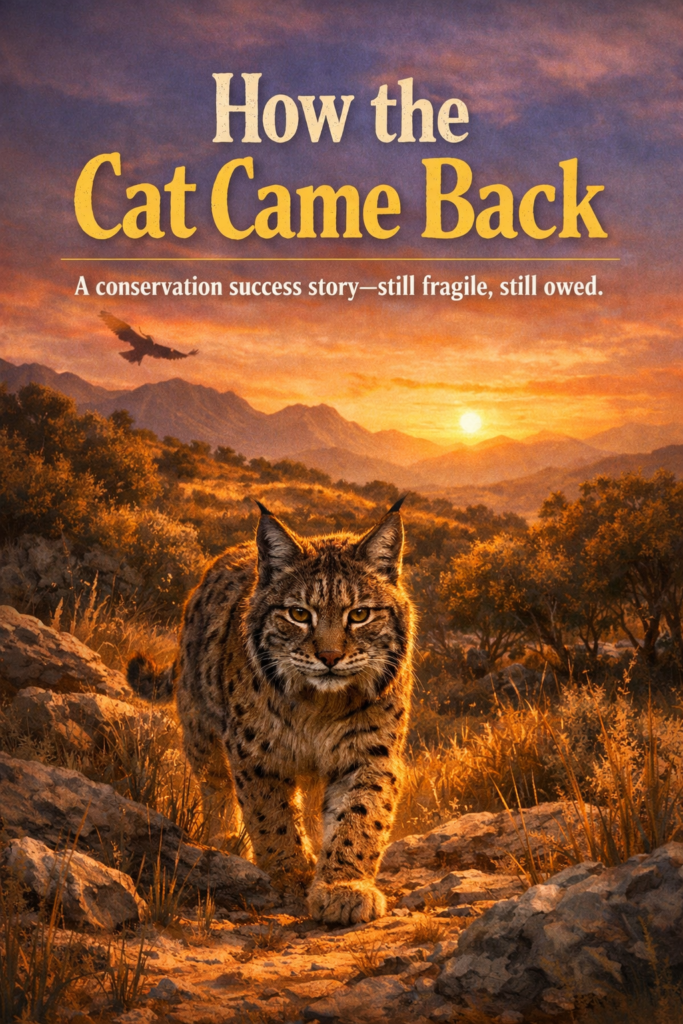
A conservation success story—still fragile, still owed.
There are recoveries you can hear coming. A stadium roar. A ribbon cut. A victory speech delivered under lights. And then there are recoveries that return the way spring does—quietly, insistently, without asking whether we deserve it. The Iberian lynx is that kind of return: a cat made of dusk and distance, a creature you do not meet so much as you are allowed to glimpse, as if the land itself is deciding how much trust to place back in human hands.
For a long time, the Iberian Peninsula carried the lynx like a fading rumor. People spoke of it the way they speak of sacred things they are not entirely sure still exist. Not myth, exactly. More like an absence that had weight. A sign of what happens when a world grows loud with roads and fences and hunger—human hunger, the kind that doesn’t know when to stop.
That is what makes the lynx story useful for this issue—Conserving the Sacred—because it refuses the easy ending. It offers a miracle with stitches showing. It gives us proof that repair is possible, and then immediately asks whether we will keep paying the price of that repair once the headlines move on. The cat came back. The debt did not disappear.
Sacredness, in this context, is not sentimentality. It is not the soft-focus language we use when we want to feel close to nature without changing our lives. Sacredness is obligation. Sacredness is the decision to protect what cannot argue with us in court, what cannot vote, what cannot speak the language of budgets and quarterly returns. Sacredness is the posture of a civilization willing to restrain itself.
The Iberian lynx forces the question sharply because it was not saved by accident. It was not saved by wishful thinking or a viral photograph or a burst of goodwill after a documentary aired. It was saved—brought back from the edge—through the slow architecture of conservation: habitat care, prey recovery, coordinated reintroductions, monitoring, law enforcement, long-term funding, and the hard work of persuading humans to share space they once treated as theirs alone. In other words: not romance. Maintenance.
If you want a single line that holds the whole story, it might be this: the lynx returned when people finally cooperated with the land instead of against it.
But to understand what kind of cooperation that is, you have to remember how close the lynx came to being gone.
Near the bottom, the world gets strangely quiet. When a species collapses, there is rarely one dramatic moment. It’s a series of small severings—this corridor broken by a road, that prey population weakened by disease, this patch of scrub cleared for development, that animal killed because it is perceived as trouble. Over time the habitat becomes a puzzle with missing pieces, and the creature becomes a ghost moving through gaps that no longer connect.
The Iberian lynx is a specialist. It belongs to a specific kind of landscape—Mediterranean scrub and woodland mosaics that seem, from a distance, rugged and resilient. But specialization is both gift and vulnerability. The lynx’s survival is tethered to the health of its habitat and, famously, to the abundance of its preferred prey: the European rabbit. When rabbits decline, the lynx doesn’t simply switch diets and carry on. It begins to unravel.
The rabbit itself has suffered waves of disease over the past decades, and with it the predator that depends on it. Add to that the pressures of fragmentation—roads slicing territories, human sprawl breaking up hunting grounds—and you get a recipe for collapse. And then, because we are human, we add the final insult: persecution. A predator becomes a target not because it is truly an enemy, but because we are uncomfortable with the idea that the landscape contains something we do not control.
For years, the lynx was held in a narrow corridor between “too rare to be seen” and “too visible to be tolerated.” It carried the old story of predators in human landscapes: we love them in theory, fear them in practice, and punish them for existing near our interests.
So what changed?
The answer is not a single program, not a single agency, not a single heroic scientist. The answer is a chain of decisions that stayed in motion long enough to matter. The lynx is a conservation success story precisely because it required a full ecosystem approach, and because it required persistence across borders, administrations, and public moods.
One of the easiest ways to misunderstand conservation is to imagine it as rescue. A helicopter lowering a net. A dramatic pull from the brink. But the truth is closer to gardening: soil, water, patience, pruning, and the willingness to keep showing up when the weather turns. The lynx did not return because it was lifted. It returned because the conditions for its return were rebuilt.
Start with the prey. If rabbits are the lynx’s bread, then rabbit recovery is not a side issue; it is the foundation. Conservation teams worked to improve rabbit habitat, to address disease pressures where possible, and to ensure that the landscape could support a stable prey base again. When you repair prey, you are repairing the entire chain of hunger that moves through the land. You are admitting—quietly, but powerfully—that an ecosystem is not a collection of separate problems. It is one problem with many faces.
Then comes habitat and connectivity: the sacred infrastructure. People like to talk about habitats as places, as if a protected area is a single dot on a map, fenced and finished. But for wild animals, survival is often a matter of movement through space—access to mates, access to food, access to shelter, access to safe crossings. A habitat without connectivity is an island. And islands create inbreeding, vulnerability, and eventual collapse.
So conservationists stitched the land back together where they could, expanding suitable areas and supporting corridors that allow lynx populations to mix. This is not glamorous work. It’s land management, negotiation, planning, long-term agreements, and sometimes outright conflict with human projects that treat open space as “unused” space. But it is the kind of work that makes an animal’s future possible.
And then, because wildness has to be defended in a human world, there is protection and enforcement: monitoring, anti-poaching measures, response teams, and the slow persuasion of communities whose lives are embedded in the same terrain. The lynx cannot be saved only by loving it; it must be saved by making it safe to exist.
Reintroductions and translocations also played a role—moving lynx into suitable areas to establish or reinforce populations. This, too, is sacred duty in practice: taking responsibility for a species’ geography after we have damaged it, and accepting that “letting nature handle it” is not a morally neutral position once humans have already tilted the table.
The results are not abstract. They can be counted.
In 2024, an official census counted 2,401 Iberian lynx across Spain and Portugal, a 19 percent increase from the previous year. That number matters not because it invites celebration, but because it demonstrates momentum—proof that a trajectory can be bent back toward life. The same accounting reported 1,557 adults and subadults and 844 cubs, and noted 470 breeding females—an especially important measure because breeding females are the future written in biological ink.
You could frame those numbers as a victory. Many will. But if this issue is going to hold its moral line, we should frame them differently: as an invoice.
Because the lynx is still fragile. Still owed.
Conservation successes carry a particular danger: they invite complacency. Once a species becomes a good-news story, it becomes easy for the broader public to assume the work is finished. It is not. Recovery is not a finish line. Recovery is a condition—one that has to be kept.
And the lynx, for all its renewed numbers, continues to die in a way that feels like a parable about modern life.
Roads.
In one recent reporting of mortality accounting, the majority of recorded lynx deaths were attributed not to starvation or disease or old age, but to vehicles. It’s a brutal image: a species hauled back from the brink by decades of coordinated effort, only to be erased in seconds by a speeding car. The asphalt becomes the altar where our priorities are revealed. We saved the lynx and then asked it to cross our highways.
This is one of the central hypocrisies of contemporary conservation: we create islands of protection and then lace the landscape between them with hazards. We rebuild corridors and then cut them again. We celebrate recovery and then fail to fund the unglamorous infrastructure—wildlife crossings, fencing, speed reductions, land-use planning—that makes coexistence possible.
If sacredness is duty, then wildlife crossings are sacred architecture.
That is not exaggeration. It is simply taking the moral stakes seriously. A civilization that claims to value biodiversity has to build for it, the way it builds for commerce and commuters. Otherwise the claim is decorative.
The lynx also offers a warning about the politics of conservation. Success depends on continuity—funding that does not evaporate with elections, laws that are enforced, protected areas that are actually protected, corridors that are not treated as “available” the moment a development proposal arrives.
This is why the lynx belongs early in this issue. It is the proof-of-life chapter. It shows that ecosystems can rebound when we treat protection as a long-term relationship rather than a campaign. It teaches that restoration is not a feeling; it’s a budget line that survives the next administration. It’s a set of policies that endure when public attention wanders. It’s the willingness to remain responsible for what we’ve harmed.
And it gives us a standard by which to judge the betrayals that follow in the rest of this magazine.
Because once you see what works—what it takes for a species to return—you can no longer pretend that destruction is inevitable. You can no longer shrug at habitat loss as if it were weather. You know that different choices are possible. You know that greed is not destiny. You know that policy matters. You know that repair is a discipline.
The lynx also quietly corrects another cultural myth: that humans are always outsiders to nature, either villains or visitors. The truth is more complicated and more challenging. We are participants. We have already shaped the system. The question is not whether humans will influence ecosystems; the question is whether that influence will be extractive or protective.
The lynx came back because, for once, protective influence held.
That does not mean the story is safe. It means the story is alive.
In spring, a landscape does something remarkable: it spends energy on new growth. It risks. It invests. Buds swell, grasses push, insects wake, birds return. The land behaves as if the future is worth the cost. But that optimism is not naïveté; it is strategy. Life continues because it must. Life continues because the alternative is silence.
The Iberian lynx is part of that spring logic. It is a creature the peninsula nearly lost, now moving again through scrub and shadow, testing whether the world has truly changed. Every cub is a question mark shaped like hope. Every road crossing is a gamble placed against our attention span.
So here is what this story asks of us, plainly.
If we want to conserve the sacred, we have to stop treating conservation as charity and start treating it as covenant. We have to accept that success does not erase obligation; it increases it. A recovered species does not mean “we can relax.” It means “we have been trusted again.”
The cat came back. The land kept its side of the bargain as far as it could.
Now we have to keep ours.
We do that by building landscapes where wildness can move without being killed for trying. We do that by funding the unglamorous work—corridors, crossings, monitoring, enforcement—year after year. We do that by refusing the idea that economic convenience outranks ecological continuity. We do that by remembering that sacredness is not what we feel when we look at a rare animal. Sacredness is what we are willing to change so that animal can live.
The Iberian lynx is still fragile. Still owed.
And that may be the truest definition of sacred duty: paying a debt we did not inherit willingly, but that we cannot refuse without becoming the kind of civilization that leaves nothing behind except roads, noise, and empty landscapes.
If spring teaches anything, it is this: return is possible. But only for those who keep the conditions for return intact.
The lynx has returned to the peninsula’s shadows.
The question is whether we will keep the shadows safe enough to hold it.
–By Noble Osborn

The theft is so quick it almost refuses to be called a theft.
A hand—small, sure, and disarmingly human—slides into a pilgrim’s open bag and comes out crowned with fruit. Someone laughs in spite of themselves. Someone scolds with the familiar irritation of a person who has scolded this same audacity for years. A vendor snaps their cloth tighter around offerings and keeps one eye on the steps. The monkey is already gone, flowing along a ledge like water that learned how to climb.
And everyone keeps moving.
Because this is holy ground. Because the rules here were not written for tourists. Because the monkeys are not guests in the way we mean it when we say “wildlife,” far-off and cinematic. They are neighbors. They are residents. They are the living punctuation of a place where sacredness has always had a body.
I became fascinated by this world while watching Monkey Thieves, a National Geographic series that follows rhesus macaques living in and around Jaipur—often framed through the “Galta Gang” at the Galta Temple complex, the city’s famous “Monkey Temple.” The show is mischievous on the surface—escapes, raids, troop politics—but what lingers isn’t the comedy of stolen snacks. What lingers is the scale of accommodation. An entire society interacting with these creatures as if they are part of the social fabric, not an interruption to it.
And they are.
At temple gates like Galta Ji, the monkeys are part of the daily operating system. People arrive already fluent in an unspoken etiquette: don’t challenge a stare, don’t clutch your bag like prey, don’t wave food like a dare, don’t panic when the little fingers test your boundaries. There is a choreography to it—half reverence, half practical wisdom, half exasperation—and it is performed with the ease of something learned through generations of cohabitation.
Sacredness, here, isn’t a soft halo. It is a negotiated truce.
You can feel it in the way “offerings” operate as a kind of currency. The line between ritual feeding and entertainment blurs fast. In some hands, fruit is devotion. In others, it’s bait for a photo, a small bribe paid to the gods of social media. The monkeys—brilliant opportunists with no investment in human symbolism—learn the difference instantly. Where food appears reliably, they stop foraging. Where humans flinch, they escalate. Provisioning changes behavior because it changes the economy of survival: why spend hours searching when the staircase provides? Researchers have documented how feeding and heavy interaction at tourist and temple sites can increase rates of contact and conflict compared with other settings, reshaping what “wild” even means in these places.
And yet, the temple endures as something more complicated than a conflict zone.
It is also a sanctuary of a strange kind: not always safe, not always kind, but still a refuge from the harsher verdict of a world that is squeezing the forest out of existence.
This is the part that matters most for Conserving the Sacred: what looks like “monkey trouble” is often an ecological story wearing a comic mask.
When forests fray—when canopy becomes islands, when fruiting trees vanish, when water sources move, when roads cut corridors into jagged pieces—animals don’t politely disappear. They adapt. They spill into the spaces we leave open: farms, rooftops, temple courtyards, city parks. They learn our schedules. They read our weaknesses. They change their diets to match the trash and the offerings and the easy calories. They become bolder not because they are morally degraded, but because displacement makes boldness a viable strategy.
So the question shifts.
Not “Why are monkeys doing this?”
But “What did we do to the landscape that made this the best option?”
The show’s premise—that sometimes it is langurs, sometimes other monkeys living in the langur temple—isn’t just a zoological detail. It is a metaphor for a world in which boundaries are dissolving. Galta Ji is commonly associated with large populations of rhesus macaques, and visitors often note the presence of langurs as well, each species carrying its own symbolism in the human imagination. Langurs often wear an aura of “guardian” in temple lore—tall, pale, watchful—while macaques carry the reputation of the trickster: clever, unruly, shameless. In the human mind, one feels like scripture and the other like satire.
But the animals don’t care what role we assign them.
They care about food. Water. Safety. Rank. Opportunity.
Which means that when we talk about sacredness as protection, we have to be honest about what it protects and what it doesn’t.
A temple can protect an animal from outright extermination. Sacredness can create a cultural barrier against cruelty, a moral hesitation that saves lives. It can teach patience, even affection, even humility: the recognition that the world is not built solely for human convenience.
But sacredness can also become a loophole—an excuse to stop thinking beyond the courtyard.
Because it is possible, even common, to revere a creature while still failing to conserve its home.
It’s possible to feed the monkey at the gate while allowing the last patch of forest outside town to be cut into smaller and smaller fragments, until “wild” becomes a memory and the only “habitat” left is stone steps and handouts.
That is the betrayal that sits at the heart of this issue.
And it is not unique to India, or to monkeys. We do it everywhere. We declare a species sacred in language—iconic, beloved, symbolic—then we treat its ecosystem like expendable real estate.
The temple monkeys just make the hypocrisy visible.
They place it on the railing where you can’t ignore it.
There is also the quieter harm that doesn’t make good television: the health and safety consequences of constant proximity. When humans and macaques share air, water, surfaces, and aggressive encounters, injuries happen—bites, scratches, sudden contact—and there are documented concerns in public health literature about exposure to pathogens in such settings. This isn’t an argument for fear. It’s an argument for boundaries. Sacredness without boundaries becomes chaos, and chaos eventually breeds resentment—resentment that can flip into cruelty when the public mood turns.
Which is why the most telling detail in modern “monkey management” is how often we try to solve a habitat problem with a theater trick.
New Delhi famously used life-size langur cutouts and “monkey men” making langur calls to deter marauding rhesus macaques around high-profile events—an attempt to weaponize an ancient predator-prey fear relationship without dealing with the underlying conditions that brought the macaques into conflict in the first place. Even the idea that “langurs keep macaques away” becomes commodified, exploited, and ethically messy when people capture or misuse langurs as living deterrents—an approach repeatedly criticized on welfare and legal grounds.
That is not stewardship. That is spectacle.
And spectacle is the opposite of sacred duty.
So what would sacred duty look like, here—at the temple gates, in the cities, in the shrinking forests?
It would start by refusing to treat monkeys as a nuisance to be solved or a cute performance to be enjoyed. It would treat them as a sign—an ecological reading on the state of the land.
A sacred approach would sound like this:
We will protect the habitat so the temple doesn’t become the last refuge.
We will stop feeding as entertainment, and regulate feeding as ritual—limited, contained, non-addictive, not a daily buffet that trains opportunism and aggression.
We will manage waste like it matters, because it does. If the landscape around a temple is a buffet of plastic and scraps, the monkeys will eat the future with the same enthusiasm they steal mangoes.
We will build and preserve corridors—green stitching between forest patches—so movement doesn’t have to mean invasion, and survival doesn’t require a raid.
We will invest in humane conflict management that doesn’t punish the animals for our land decisions.
We will educate visitors not in fear, but in literacy: how to move, how to hold food, how to respect distance, how to read warning signals, how to leave without making the animals pay for a human mistake.
And—most importantly—we will widen the definition of sacred.
Not sacred as “the place where we take photos.”
Sacred as “the living system that makes the place possible.”
Because if we only protect monkeys when they are framed by temple stone, then we have reduced sacredness to decoration. We have turned reverence into an aesthetic choice.
But the monkeys don’t live in aesthetics. They live in ecosystems.
Which means the truest sanctuary is not the staircase where the theft happens.
It is the forest that makes theft unnecessary.
This is what Monkey Thieves reveals, almost accidentally, through its humor: a society already practicing a kind of day-to-day diplomacy with the nonhuman. A civilization that has, for centuries, allowed wild minds to exist within arm’s reach of the sacred. That is not nothing. That is not small. That is a cultural resource we should be protecting as fiercely as any species.
But diplomacy only holds when both parties have somewhere to go.
If the forest continues to vanish, the temple becomes less a sanctuary and more a crowded lifeboat. And lifeboats change people. They change animals. They change the rules.
In spring, we like to tell ourselves rebirth is automatic. That the world will green again because it always has. But rebirth is not a guarantee—it is an agreement.
At the temple gates, the monkeys keep reminding us: agreements require maintenance.
A stolen piece of fruit is funny, until you understand what it means.
It means the forest is knocking—again—on the door of human life.
And asking, in the only language it has left:
Will you make room for me out there… or only here?
-By Noble OSborn
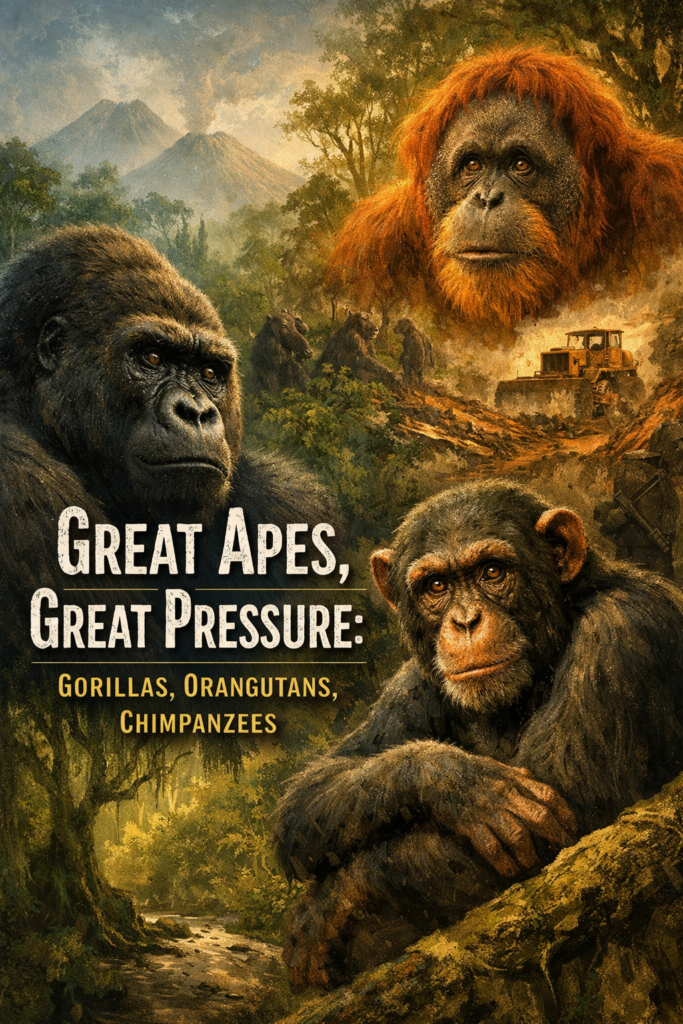
There are animals we love the way people love saints—by turning them into symbols and then acting surprised when the world treats symbols like decorations. Great apes are not decorations. They are our closest living witnesses: they grieve, they play, they teach, they wage small wars over fruiting trees, they cradle their young with the same fierce tenderness we pretend is uniquely human. When we destroy their homes, we are not merely “losing biodiversity.” We are vandalizing a kind of kinship.
This is the part of the story where the word sacred stops being poetic and becomes practical.
Because “sacred” does not mean untouchable. It means protected. It means there are lines you do not cross, even when crossing would be profitable.
And right now, those lines are being crossed everywhere—by chainsaws, by roads, by fires, by mines, by markets, by war. If you want to understand the moral shape of our environmental era, you can start with three mirrors held up to the human face: gorillas, orangutans, chimpanzees. Each one reflects a different kind of pressure, a different kind of betrayal. Together, they form a single warning: we are running out of room to pretend we can love what we are willing to erase.
1) Gorillas: a success that still bleeds at the edges
The gorilla story is often told as a victory hymn—because in some places it is. Mountain gorillas have clawed back from the brink through decades of protection, veterinary intervention, anti-snare patrols, and the slow discipline of conservation done the hard way: day after day, ranger by ranger, community by community. The numbers have risen; the headlines celebrate.
But the victory is narrow, like a path cut through a steep forest. Step off it and you immediately feel what remains true: gorillas live in a neighborhood of instability.
Their habitat is finite and hemmed in—forests bordered by farms and families who need land, countries where political tremors and armed conflict can make a protected area feel like a paper promise. Even when poaching is reduced, the danger doesn’t evaporate; it changes costumes. Disease can pass from humans to gorillas with terrifying ease. Tourism funds protection and also creates another thread of vulnerability if economies collapse or borders close. Rangers die doing this work. Communities absorb costs the world rarely accounts for.
So yes: gorillas demonstrate that protection works. But they also reveal the fragility of “working.” Conservation isn’t a finish line—it’s a pressure system. If you stop holding the line, the line dissolves.
In a sacred framing, the gorilla is the altar that proves the faith can be lived. The question is whether we have the stamina to keep living it.
2) Orangutans: the economics of erasure
Orangutans live in a different kind of violence—one that doesn’t always look like violence from far away.
A forest can be killed politely.
A forest can be killed with permits, paperwork, and the promise of “sustainable” practices. It can be killed by converting complexity into a commodity: peatlands drained, canopy thinned, corridors severed, the living architecture of the jungle simplified into neat rows that photograph well from a plane. This is the language of progress that keeps its hands clean while it breaks a world.
Orangutans are arboreal beings—creatures shaped by the vertical, by the braided pathways of branches. Fragment that world and you don’t only reduce habitat; you fracture an entire way of being. When fires burn—especially in dried peat landscapes—the destruction is not just immediate; it lingers in soil and smoke, turning seasons into threats. When floods and extreme weather events hit a forest already carved up, the losses aren’t “natural disasters” so much as amplified consequences.
The orangutan story is not simply about an endangered animal. It is about how modern economies metabolize land. It is about how quickly sacredness is revoked when something becomes profitable.
This is the betrayal in its purest form: not hatred, but conversion. Turning a living sanctuary into a product line and calling it development.
If gorillas ask whether protection can work, orangutans ask whether we will stop rewarding destruction.
3) Chimpanzees: the frontline of proximity
Chimpanzees, more than the others, occupy the dangerous intimacy of being near us—not just genetically, but geographically. Their story is not only forest loss; it is the bleed of human life into wild life.
Roads are the spear tip here. Roads do not merely enter a forest; they invite everything that follows: logging, mining, settlement, trafficking, opportunistic hunting, “accidental” snares, the casual commerce of bushmeat. Once a road arrives, the forest’s privacy is gone.
Chimpanzees are also vulnerable to the human body itself—our diseases, our pathogens, the invisible consequences of contact. When conflict displaces people, protected spaces become survival zones, and the moral math gets painfully complicated: a family clearing land to eat is not the same as a corporation clearing land to profit, but the forest does not survive either way. Sacredness is tested not only by greed but by desperation.
And chimpanzees, being the innovators they are, sometimes adapt just enough to keep us from noticing what’s being lost. They move at the margins. They raid crops. They shift their ranges. They persist in broken places until even persistence becomes impossible.
Chimps are the mirror that shows us how thin the boundary really is. They are the warning that “coexistence” is not a slogan; it is a hard design problem with moral stakes.
The shared truth: we don’t lose apes by accident
Put these three stories side by side and a pattern forms.
Great apes don’t disappear because we lack knowledge. We know what destroys them: habitat fragmentation, extractive industry, weak enforcement, conflict, fire, disease, and the market incentives that make all of the above feel inevitable.
They disappear because we keep choosing a world where sacredness is optional.
What makes this issue of conservation uniquely spiritual—whether your faith is religious, ecological, or simply human—is that apes strip away our excuses. You cannot look into their eyes and pretend you didn’t understand.
So here is the central question this trio asks the reader:
If we can coordinate across borders, fund protection, train rangers, build corridors, restore prey, support communities—if we can do all that for gorillas—why do we still reward the systems that flatten orangutan forests? Why do we still build roads into chimpanzee sanctuaries as if the forest were empty land waiting for our permission?
And here is the harder follow-up:
If “sacred” means anything, what are we willing to stop doing?
A sacred duty that looks like real work
Conserving the sacred is not a feeling. It is not the warm glow of liking wildlife content and then going back to life as usual.
It looks like policy, enforcement, and budgets that don’t evaporate when the news cycle changes.
It looks like land rights and local stewardship supported, not romanticized.
It looks like supply chains that do not hide devastation behind green words.
It looks like protected areas that are protected in practice—funded, patrolled, connected, and defended.
It looks like the humility to admit that “progress” that requires erasing kin is not progress at all.
Spring teaches us that renewal is possible—but it also teaches us that renewal demands conditions: water, soil, time, restraint. Seeds do not sprout in a fire.
Great apes are not asking us to be perfect. They are asking us to be honest.
And then to act like we meant it.
–By Noble Osborn
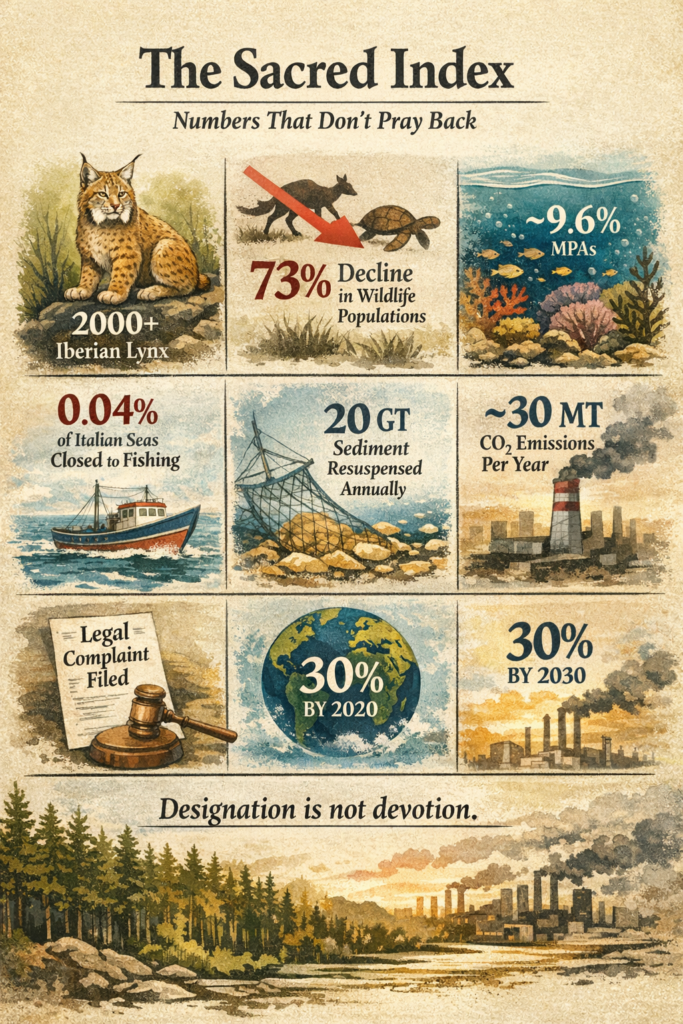
The Sacred Index
Numbers That Don’t Pray Back
Some numbers are not neutral. Some are testimony. They tell us what we’ve protected, what we’ve pretended to protect, and what we’ve sold while still calling ourselves “stewards.”
1) The comeback that proves repair is possible (LAND)
Iberian lynx: more than 2,000 individuals (IUCN estimate, 2024).
What it means: When habitat, prey, policy, and patience align, recovery isn’t a slogan—it’s a headcount.
2) Wildlife in freefall (LIFE)
Average monitored wildlife populations: down 73% (1970–2020).
What it means: The sacred isn’t “vanishing someday.” It’s shrinking on our watch—fast.
3) “Protected” ocean vs protected ocean (SEA)
~9.6% of the ocean is designated as Marine Protected Area (MPA) (global tracking, 2025).
But only ~3.2% is fully or highly protected (quality of protection, not just lines on a map).
What it means: A sanctuary in name only is still an extraction zone.
4) Italy’s hard truth (SEA / POLICY)
Only 0.04% of Italian seas are closed to fishing (reporting focused on “fully protected” closure).
What it means: We announce “protection,” then leave the door open.
5) The seabed as a carbon vault (SEA / CLIMATE)
A 2024 Nature Geoscience paper reports bottom trawling resuspends more than 20 gigatonnes of sediment annually on global continental shelves.
What it means: This isn’t only “fishing.” It’s industrial disturbance of the planet’s living skin.
6) Carbon consequences aren’t theoretical (SEA / CLIMATE)
Modeling work summarized by U.S. Ocean Carbon & Biogeochemistry suggests bottom trawling could drive ~30 million tonnes of CO₂ annually (global) in their estimates.
What it means: The ocean floor is not an infinite rug we can keep beating clean.
7) “Paper parks” are now a legal argument (SEA / LAW)
NGOs have filed legal complaints arguing that some EU countries (including Italy) are failing to protect vulnerable marine ecosystems in MPAs, with destructive activity continuing.
What it means: Even the law is starting to say what the water has been saying: protection must be real.
8) The 30×30 goal is a clock, not a wish (SEA / GLOBAL)
The “30% protected by 2030” target is widely framed as essential to biodiversity recovery; it’s also a measuring stick for political honesty.
What it means: Every year we delay, we normalize the lie.
9) A final reading
Designation is not devotion.
If a place is “protected” but trawled, drilled, bulldozed, poisoned, or quietly defunded—then what we protected was our conscience, not the land.
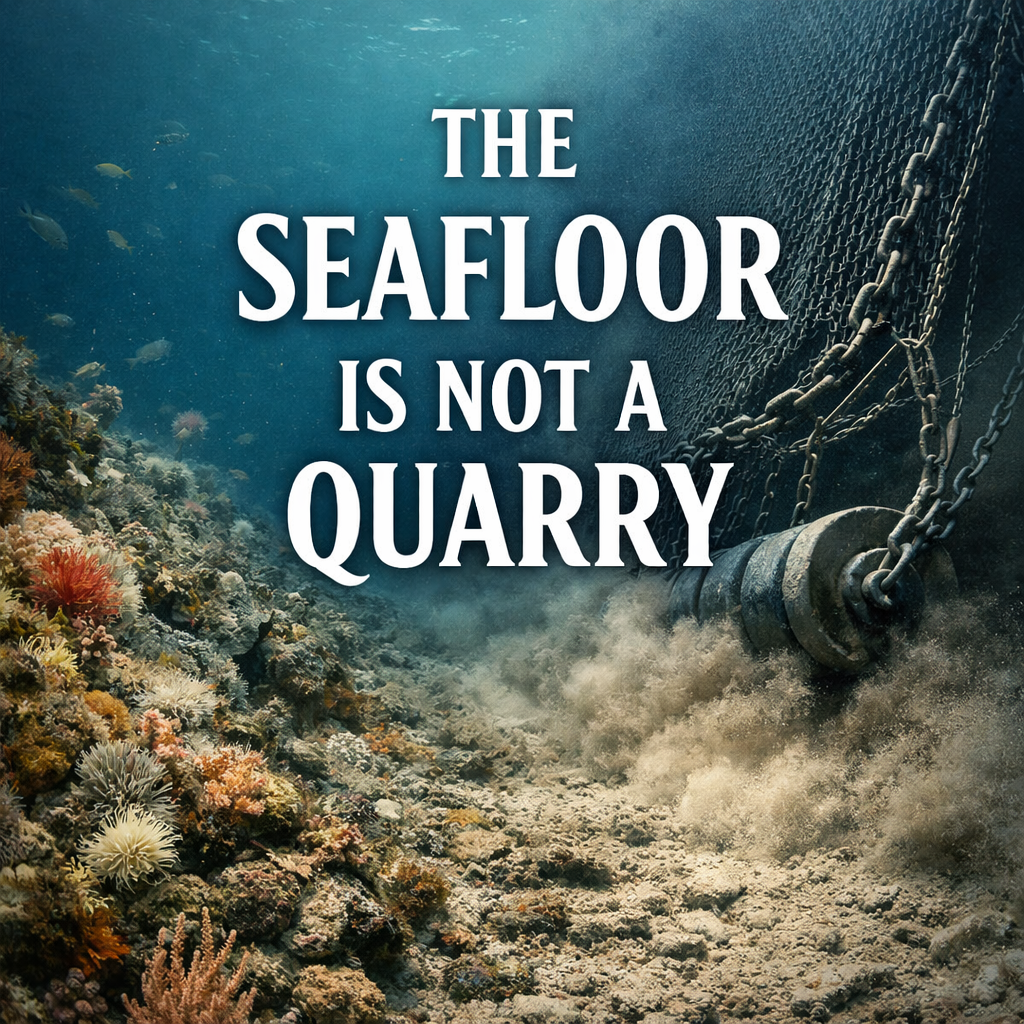
There are places in the world that do not glitter. They do not advertise themselves. They do not have postcards or promenades or souvenir shops selling tiny versions of their bones. They exist in the dark, in the cold, in the pressure-heavy silence where the ocean keeps its oldest secrets.
The seafloor is one of those places.
It is not empty. It is not wasteland. It is not a blank canvas beneath a blue surface. It is habitat, archive, nursery, and pantry. It is a living skin stretched over the planet’s most ancient body, and it supports a civilization of creatures most of us will never see.
And then we drag steel across it.
Bottom trawling is described politely in technical language: nets pulled along the seabed to catch fish and shellfish. But the practice is not gentle. It is heavy gear, chains, doors, dredges—mechanized force designed to disturb what lives on and in the bottom so it can be gathered up. It is fishing that resembles demolition.
Imagine calling a forest “protected,” then driving bulldozers through it because you’re only trying to catch the deer.
That’s what it feels like when you learn how often bottom trawling happens inside areas labeled “protected.” Across Europe and the UK, investigations and reporting have shown trawling and dredging still occur in many marine protected areas—places the public assumes function as sanctuaries.
We have invented a language that can bless a place without defending it.
We call them MPAs—Marine Protected Areas—and the phrase is soothing. It suggests a boundary. It suggests restraint. It suggests we have learned something. But too often, “protected” means “mapped,” “designated,” “announced,” and then quietly compromised. In the real world, that means nets and chains continue to scrape the bottom in places that were supposed to be safe.
This is not just about fish. It’s about the kind of relationship we believe we have with the living world.
The seafloor is a cathedral built in slow time. Corals can take centuries to grow. Seagrass beds can take decades to establish. Sediments hold carbon that accumulated over millennia. The sea keeps accounts patiently, the way old trees do. And in a few passes of industrial gear, we can erase what took generations to become.
There is a climate dimension here that makes the moral dimension even sharper. Seabed sediments store organic carbon. When trawling disturbs the sediment, some of that carbon can be converted into dissolved CO₂ in the water column and, over time, a portion can reach the atmosphere. Recent research attempts to quantify this “trawling-induced CO₂” pathway, and while the precise totals are debated, the broad warning is clear: disturbing seabed carbon at industrial scale is a climate problem we have barely acknowledged.
We talk about keeping carbon in the ground.
But we have been dragging carbon out of the sea.
That truth does something to the stomach. It turns “fishing method” into “planetary disturbance.” It makes the seafloor feel less like a resource and more like a trust—something we are borrowing from the future.
So why do we keep doing it?
Because the practice is normalized. Because the costs are underwater and the profits are on land. Because enforcement is harder at sea. Because policy has lagged behind science. Because, in many places, we have treated “protection” as a branding exercise: create the boundary on paper, then negotiate it into meaninglessness.
And because we have told ourselves a comforting story: that the ocean is so vast it can absorb anything.
It cannot.
Momentum is building in public conversations and political corridors, and you can feel the shift: proposals to restrict bottom trawling in protected waters, parliamentary pressure, public consultations, larger conversations about what MPAs are for and whether “partial protections” are protection at all.
But the fight is not about whether officials can say the right words. It is about whether those words become boundaries that hold.
A sanctuary is not a sanctuary if the violence is permitted inside it.
This is where “Conserving the Sacred” stops being metaphor and becomes a test. Sacredness is not the same as beauty. Sacredness is not the same as a nice feeling when we watch a nature documentary. Sacredness is a claim: this matters enough to restrain ourselves.
Which means the real question is not “Should we protect the ocean?”
The real question is: what are we willing to stop doing?
Stewardship does not require perfection. It requires clarity. It requires choosing methods that do not destroy the foundation of life while trying to harvest its fruits. It requires that protected areas be actually protected: no bottom trawling, no dredging, no loopholes that turn boundaries into suggestions. It requires transparency—tracking where trawlers go, enforcing rules, and making consequences real.
It also requires fairness. Coastal communities and fishers should not be asked to carry the cost alone while industrial fleets continue as usual. If we transition away from destructive gear, we must support the people whose livelihoods have been shaped by systems they did not design. We must make a path where living with the ocean is not a punishment.
Conserving the sacred is not anti-human. It is pro-future.
Because the ocean is not just scenery. It is oxygen, climate regulation, food security, wonder, and the deep baseline of life on Earth. When we tear up the seafloor, we tear up something we do not know how to replace.
Spring teaches us that renewal is real—but only when something is allowed to rest, to regrow, to return.
So here is the vow this essay asks for:
Let the seafloor be more than a workplace.
Let it be a sanctuary we can name without lying.
Let the ocean keep what it has been keeping for millennia.
–By Noble Osborn
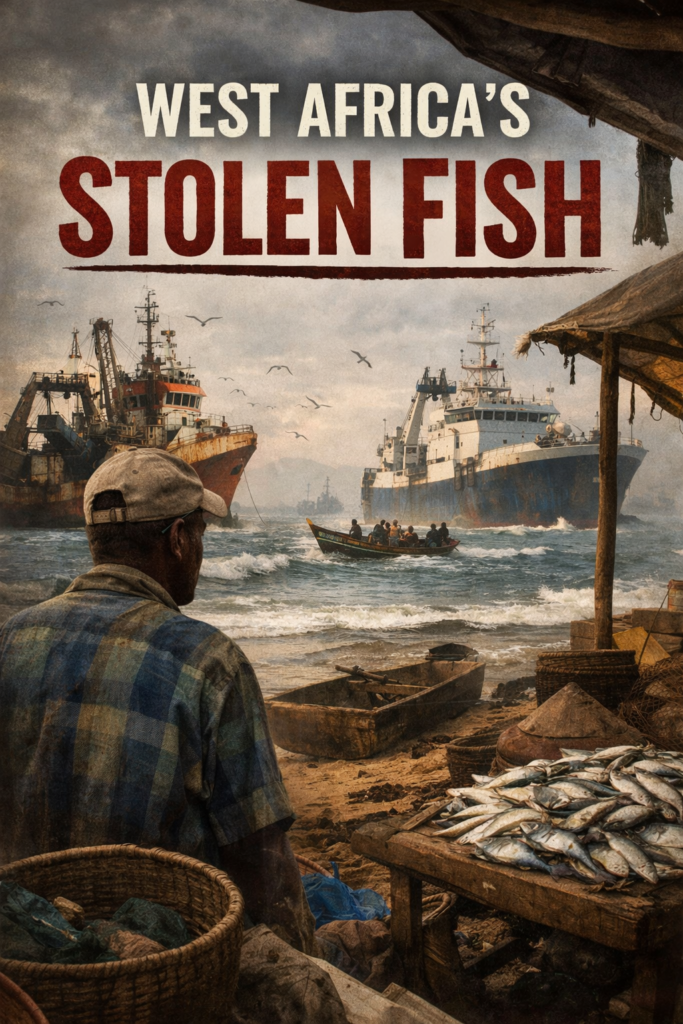
When the ocean is a pantry, a paycheck, and a prayer—and industrial fleets arrive like locusts.
There are places where the sea is not scenery. It is calendar, inheritance, and social contract. It tells you when weddings happen and when debts get paid. It decides whether a grandmother has protein for soup, whether a teenager stays in school, whether a boat gets repaired or quietly rots in the sand.
Along West Africa’s coast, that relationship is fraying into something uglier: a fight over what should have been sacred. Not sacred in a sentimental way—sacred as in non-negotiable. The kind of sacred that keeps a society standing.
And when that sacred bond breaks, the consequences are not only ecological. They become economic. Then political. Then humanitarian. Sometimes they become a body lost at sea on the way to another continent.
The shoreline as a ledger
The coastal towns—especially in Senegal, Gambia, Mauritania, Guinea-Bissau, and Ghana—have lived for generations with an assumption as ordinary as breathing: the sea will feed us if we fish with restraint and knowledge. Small boats, seasonal patterns, gears that avoid the nursery grounds because everyone knows you don’t eat tomorrow to satisfy today.
Then the industrial age anchored offshore.
It doesn’t announce itself with a flag you can trust. It announces itself with scale: hulls that dwarf artisanal canoes, nets that sweep wide as hunger, storage capacity designed for export, not for local markets. The sea becomes a spreadsheet: tonnage in, profit out. A floating factory, a floating loophole, a floating denial.
Local fishermen will tell you the same story in different accents: once, you went out and came back with a haul that felt like the sea saying yes. Now you go out and come back with the kind of empty that feels like the sea saying someone else already took it.
“Legal” theft and the fog of paperwork
One of the most corrosive realities is that much of this plunder is not committed in the cinematic way we imagine “piracy.” It happens through contracts, licensing, and a haze of beneficial ownership that makes responsibility evaporate.
A vessel may be foreign-owned but locally flagged. Or foreign-controlled but legally “present.” Or licensed for one zone and fishing in another. Or recorded as catching one species while the hold tells a different truth. Or operating with paperwork that looks clean in a capital city while communities watch the nets tear up their nearshore waters.
This is the modern method: not always breaking the law loudly, but bending it until it can no longer hold.
The result is a coastline where legitimacy is contested. If an industrial trawler is “licensed,” but it trawls where small-scale boats are supposed to be protected, what do you call that? If the rules exist but aren’t enforced, what do you call that? If the fish vanish while the paperwork stays pristine, what do you call that?
In many villages, the answer is simple: stolen.
The inshore zone: where the sacred becomes most vulnerable
Most West African countries designate inshore areas where industrial fishing is restricted or banned—waters meant to protect artisanal fishers and nursery habitats. On paper, it’s the boundary between subsistence and extraction.
In practice, it’s where conflict ignites.
Because the inshore zone is where life begins: juvenile fish, spawning grounds, the ecological equivalent of a maternity ward. When trawlers push into these waters—whether through corruption, weak monitoring, or sheer impunity—they aren’t just competing. They’re erasing the future stock.
And when that happens, local fishermen don’t simply lose fish. They lose dignity. Their nets are destroyed. Their engines are damaged by wake and collision. Their sense of safety collapses. In some places, that tension has boiled into violence—boats attacking boats, neighbors turning on neighbors, the sea becoming a battlefield instead of a commons.
When people say “resource conflict,” this is what it looks like in real life: not a theory, but a man returning with shredded gear and a child looking at an empty cooking pot.
The fishmeal trap: turning dinner into commodity dust
Even when fish are caught “legally,” another betrayal slips in through the supply chain: fish that should be feeding local communities get reduced into fishmeal and fish oil for export-driven industries.
Small pelagic fish—sardines, sardinella, mackerel—are the backbone of coastal diets. They are also the backbone of certain industrial appetites: aquaculture feed, livestock feed, export markets that pay in currencies local people never touch.
Fishmeal factories don’t need to invade your waters to harm you. They only need to change the destination of your fish. They create a perverse gravity: the sea is pulled away from the market stalls and into a pipeline that ends somewhere else—someone else’s farmed salmon, someone else’s profit margin, someone else’s “sustainability” label.
For a community already living close to the edge, this is not an abstract injustice. It’s the difference between nourishment and malnutrition. Between stable prices and inflation that makes fish—the very thing you fish—too expensive to eat.
“Go dark”: the new invisibility
There is another modern weapon used offshore: disappearance.
Industrial fleets can switch off tracking systems, obscure identity, or operate at the edge of enforcement where law becomes suggestion. In this shadow zone, “we didn’t see it” becomes a policy.
But the ocean keeps receipts now. Satellite monitoring, open vessel tracking platforms, and investigative reporting increasingly show patterns that were once deniable: repeated incursions, suspicious behavior, fishing effort clustering near protected zones, and vessels that wink out—go dark—right where scrutiny would be most inconvenient.
This doesn’t automatically produce justice. But it changes the moral equation. When the public can see the patterns, denial becomes harder to sell. Transparency becomes its own form of resistance—if governments and consumers are willing to act on what they can now plainly witness.
In Senegal, the story has sharpened into a brutal triangle: fish depletion → livelihood collapse → migration.
Senegal: when depletion turns into migration pressure
When the sea no longer pays, people look for another way to survive. When a fisherman cannot fish, he is not merely unemployed; he is dispossessed of identity, skill, and inheritance. A boat is not just a tool. It is status. It is continuity. It is a future.
Take that away, and the horizon changes shape.
Some head for cities. Some sell their boats. Some borrow money they can’t repay. Some choose a different kind of sea journey—one that is not about catching fish but about leaving, often toward Europe, often in dangerous conditions.
This is what “environmental crisis” looks like when it reaches the human body: lungs full of saltwater, a coastline full of grief, and policy discussions that still treat fish like an export statistic instead of a cornerstone of social stability.
The convenient myth: “There are plenty of fish”
One of the most damaging lies in this story is a comfortable one: that the ocean is infinite, that depletion is temporary, that new technology will always “find” more fish.
But fish are not only biomass. They are relationships. Food webs. Nursery grounds. Temperature tolerances. Spawning cycles. And they are not evenly distributed across time and space. When you hammer a stock hard enough—especially nearshore—you don’t just “reduce” it. You destabilize it.
The sacred betrayal is not only the taking. It’s the taking without restraint, and the expectation that the system will keep forgiving you.
Who benefits?
If you follow the money, the beneficiaries are rarely coastal households.
Profits flow to distant owners, to intermediaries, to markets that can pay more than local buyers. They flow through legal structures that hide responsibility: foreign-controlled vessels under local flags; foreign investment shielded by layers of corporate ownership; supply chains that wash seafood clean by the time it reaches a plate in another hemisphere.
And then there are the secondary beneficiaries: political actors who gain influence through access agreements; agencies that take fees without strengthening enforcement; networks that profit from opacity.
Meanwhile, communities pay in the currency of hunger and anger.
What would “conserving the sacred” actually require?
Not slogans. Not one-off “clean-up” operations. Not performative treaties that never reach the pier.
It requires a commitment to enforcement that matches the scale of extraction. It requires transparency strong enough to make beneficial ownership visible. It requires closing loopholes that allow foreign profits to flow from illegal or abusive practices. It requires inshore zones that are truly protected, not protected on paper.
It also requires treating small-scale fishing communities as stakeholders, not scenery—bringing them into decision-making, recognizing their knowledge, and protecting their access.
And, crucially, it requires consumer markets—especially large importers—to stop pretending this is someone else’s problem. If you are buying seafood, you are part of the story. If your supply chains reward opacity, you are funding the theft of the sacred.
The closing image: a market stall and an empty tray
There is a simple way to understand what’s at stake: look at a fish market when the boats return. Watch what disappears.
A market stall with less fish is not just a market issue. It’s a nutrition issue. A public health issue. A youth employment issue. A migration issue. A stability issue.
In West Africa, the stolen fish are not only fish.
They are time. They are continuity. They are the right to remain.
And if this issue is truly about conserving the sacred, then this essay’s claim is blunt:
The ocean is not a loophole. The nearshore waters are not a sacrifice zone. And a coastline’s food supply is not a commodity to be vacuumed up by the highest bidder.
The sacred is not what we admire.
The sacred is what we refuse to sell.
–By Noble Osborn
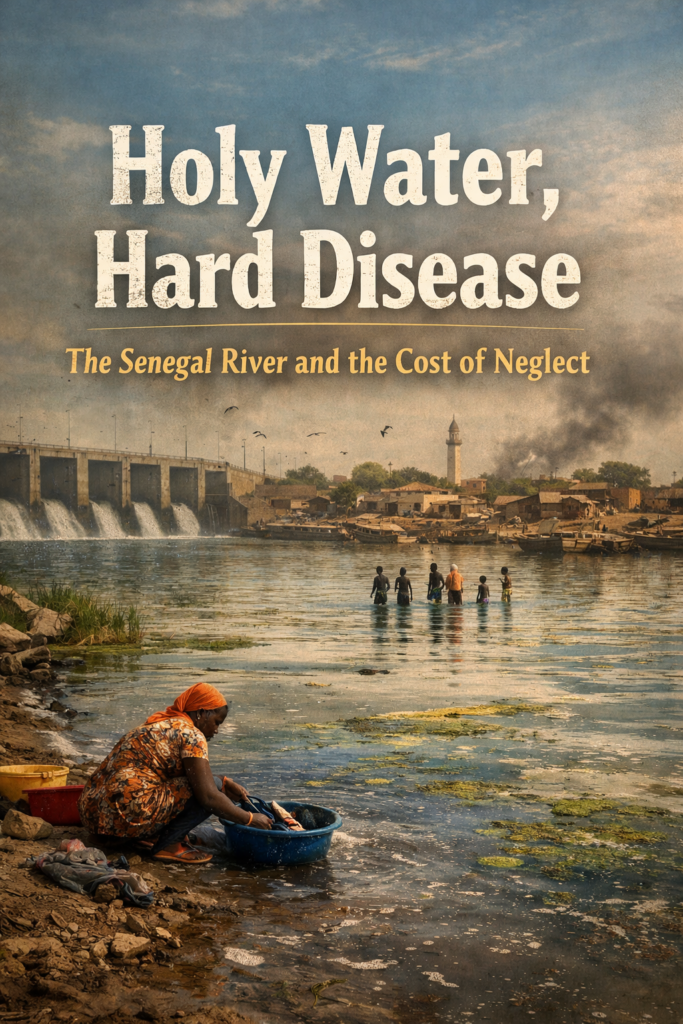
There are places where water is more than water. It is inheritance, boundary, bread, and blessing. It is a line of green written through a landscape that would otherwise be dust and thorn. Along the Senegal River, that sacredness is not metaphor. The river is livelihood: fields drink from it, cattle follow it, cities rise beside it, and families wash in it because there is nowhere else to go.
And yet—this is the cruel twist of modernity—what should be holy has been made hazardous.
This is the story of a river that was engineered to save people, and then quietly turned into a machine that helps a parasite thrive. It is the story of how “development” can look like protection and still become betrayal. It is the story of schistosomiasis—an ancient waterborne disease—finding a perfect home in the wake of dams, irrigation, and neglect. And it is, at heart, a story about what we refuse to see when we treat ecosystems as plumbing.
A river redesigned
In the late twentieth century, the Senegal River became a grand promise. Dams were built to tame salt intrusion, secure freshwater supplies, stabilize agriculture, and generate power. The logic was elegant: control the river, and you control hunger. Hold back the sea, and you protect the farms. Make water reliable, and you make life reliable.
On paper, this is the language of stewardship.
In practice, it is also the language of unintended consequences.
When you dam a river, you don’t just change water levels. You change the river’s memory—its seasonal pulse, its salinity, its chemistry, the movement of its animals, the breeding cycles of its predators, the distribution of its snails, the places where people stand knee-deep to wash clothes, the slow geometry of daily life.
You create stillness where there used to be surge. You create permanent water where there used to be seasonal dry-outs. And in tropical systems, stillness is not neutral. Stillness is opportunity—especially for organisms that thrive when water sits warm and shallow and predictable.
Enter the parasite.
The invisible tenant
Schistosomiasis is caused by parasitic worms whose life cycle depends on freshwater snails. The parasite’s larvae are released into the water, penetrate human skin during contact—washing, wading, bathing, working—and then mature inside the body. People do not have to drink the water to be infected. They only have to live with it.
This is what makes the disease so morally sharp: the very act of touching your own river—your source of life—becomes the doorway to illness.
Schistosomiasis can cause chronic pain, anemia, fatigue, organ damage, and long-term complications that quietly grind down communities. It is not a dramatic plague that sweeps through with headlines and sirens. It is a slow theft. It steals energy. It steals school days. It steals work capacity. It steals pregnancy health. It steals the feeling that your body belongs fully to you.
In places where medical access is inconsistent and water contact is unavoidable, the disease becomes not only a health issue but a social condition—an everyday drag on possibility.
The dam’s shadow
If you want to understand why schistosomiasis flourished along parts of the Senegal River, you have to look at the ecological chain reaction.
When dams reduce salinity and stabilize freshwater, the snail hosts can multiply. When irrigation canals expand, the habitat for snails expands with them—quiet, shallow channels where the water is just slow enough, warm enough, and protected enough for snails to thrive. When people cluster around reliable water for farming and domestic needs, human contact with snail habitat intensifies.
And then there is a deeper possibility—one that reads like a parable: what if the river lost not only its seasonal rhythm, but its guardians?
There is a compelling idea that migratory river prawns (natural snail predators) once helped keep snail populations in check. Dams can disrupt migrations, reducing predator abundance upstream, which may allow snail populations—and therefore transmission—to rise. Whether the pincer is the whole story or only part of it, the theme holds: when you block the river’s old relationships, you don’t get a “controlled river.” You get a rearranged river. And rearranged ecosystems often favor the opportunists.
Schistosomiasis is an opportunist.
So are we.
Sacred waters poisoned, not only by parasites
Disease isn’t the only betrayal. Pollution and poor sanitation can turn a sacred river into a risk in multiple ways at once.
Untreated wastewater, agricultural runoff, and expanding urban pressures degrade water quality and increase the burden on people who already have few alternatives. When sanitation infrastructure lags, rivers become both wash basin and sewer. When agriculture intensifies without safeguards, nutrients and contaminants ride the water downstream. When access to clean water is unreliable, people return again and again to the river—because they must—multiplying exposure.
Here is the hard truth: we often speak of “environmental harm” as if it is separate from “human harm.” Along the Senegal River, the separation collapses. The river’s illness becomes the body’s illness. The pollution you can smell becomes the fatigue you can’t explain. The engineering that promised abundance becomes the landscape where infection is routine.
This is what it means when we say sacred waters have been poisoned—not as poetry, but as policy.
A geography of inequality
It matters where you live along the river. It matters whether your house is served by reliable water systems or whether the river is your only tap. It matters whether you can afford private healthcare or whether you wait. It matters whether you are a child who plays in the shallows, a farmer who irrigates by hand, a woman doing laundry, a worker standing in canals.
Disease maps itself onto class, onto gender, onto labor. Schistosomiasis is sometimes called a disease of poverty, but that phrase can become lazy—as if poverty is the cause rather than the condition that makes prevention impossible.
The true cause is neglect wrapped in inevitability.
When we accept that some communities will simply “live with” waterborne disease while others drink filtered water without thinking about it, we aren’t witnessing tragedy. We are choosing it.
The sacred duty we keep dodging
This issue is themed Conserving the Sacred. The Senegal River forces the theme into a sharper shape: sacredness is not a feeling. It is a duty measured in infrastructure, budgets, and follow-through.
If the river is sacred, then so is the right to touch it without harm.
Conservation here is not only about species and forests—though those matter. It is about the ethics of development. It is about the moral accounting that comes after the ribbon-cutting ceremonies.
Because dams are not villains by default. They do bring benefits—water security, salt intrusion control, irrigation potential, electricity. The betrayal happens when we stop at “benefits” and refuse to pay for “consequences.” When we build the structure but not the public health shield around it. When we expand irrigation without building sanitation. When we celebrate stability and ignore what stability enables.
A sacred river demands we hold both truths at once: the human need for water security and the ecological reality that engineered systems can become disease systems.
What repair looks like
Repair starts with refusing the false choice between “health” and “development.” The goal is not to undo history, but to keep the promises we already made.
- Treat the disease—consistently, not occasionally
Mass drug administration can reduce the burden, but it has to be sustained and coordinated. Treatment campaigns can’t be treated as one-time heroics; they must be part of a durable public health rhythm. Monitoring matters. Follow-up matters. Re-infection is a reality if exposure remains constant. - Reduce exposure by changing water contact realities
This is where sacred duty becomes very practical:
- Safe water points so families don’t need to rely on the river for every domestic need.
- Sanitation and wastewater treatment so the river isn’t continually seeded with contamination.
- Community-designed washing stations and laundry platforms that reduce contact with snail habitat.
- Behavior change support that respects the reality that people can’t simply “avoid the river” when the river is their life.
- Design irrigation like a health intervention, not only an economic one
Canals can be managed to reduce snail habitat—through flow management, lining, vegetation control, and maintenance schedules. The details are unglamorous, which is why they’re often underfunded. But a sacred duty is rarely glamorous. It is repetitive. It is disciplined. It is maintenance. - Restore ecological checks where possible
If predator disruption is part of the story, then restoring predator presence—where feasible—becomes part of disease control. It’s an unsettling but hopeful thought: that biodiversity is not only beautiful, but protective. That a river’s food web can be a public health system if we allow it to function. - Govern the basin like the transboundary body it is
A river doesn’t care about borders. Disease doesn’t either. Basin governance has to take health seriously as an environmental outcome—not a separate sector that gets whatever crumbs are left after the “real” projects are funded.
What we owe the river
When people speak about sacredness, they often mean “untouched.” But the Senegal River is not untouched. It is managed, engineered, relied upon, and altered. Its sacredness now must mean something else: not purity, but responsibility.
A sacred river is one we refuse to abandon after we reshape it.
It is one we refuse to treat as a simple conduit for water deliveries and crop yields.
It is one we care for as a living system—because living systems push back when simplified.
The Senegal River is pushing back in the language of parasites and pollution. It is saying, in the only vocabulary it has: you changed the rules, and now you must live with what your new rules allow.
But we do not have to accept that the cost is paid by the most vulnerable.
Spring is the season we pretend we are capable of learning. The season we tell ourselves that rebirth is natural, that repair is possible, that what was damaged can bloom again. Along the Senegal River, spring has a harsher lesson: rebirth doesn’t happen because the calendar turns. It happens because we do the work.
Conserving the sacred is not only saving a species or protecting a forest. Sometimes it is building a wastewater system. Sometimes it is funding routine treatment. Sometimes it is maintaining canals so they don’t become nurseries for disease. Sometimes it is remembering that water is not merely a resource—it is a relationship.
And a relationship, once betrayed, demands more than apology.
It demands repair.
–By Noble Osborn
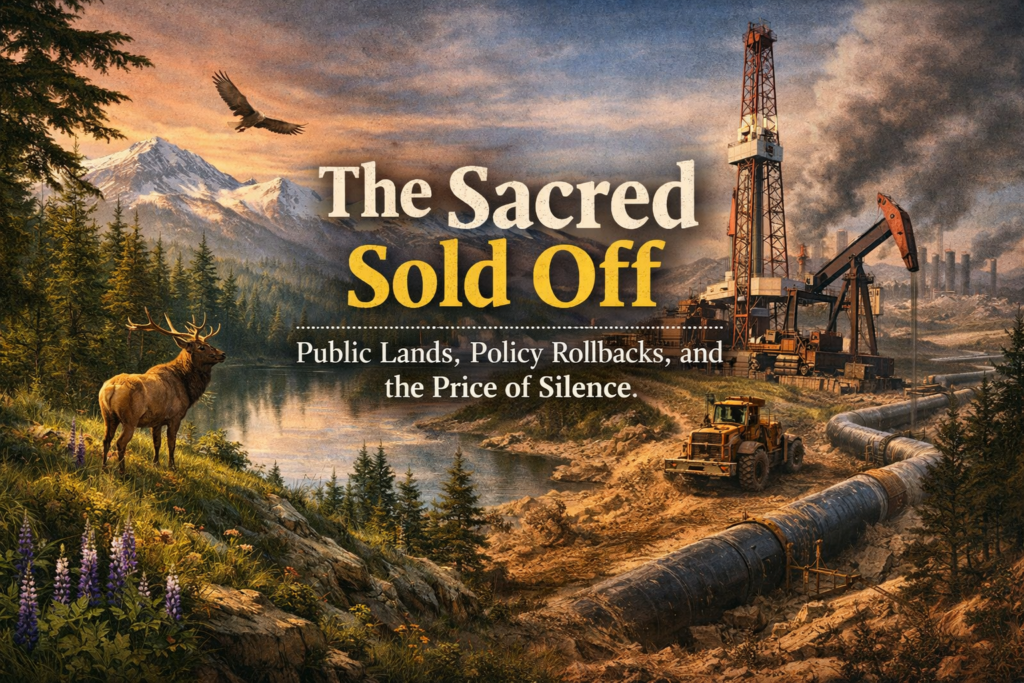
When “management” becomes a euphemism for taking, the wild is asked to pay in advance.
I keep thinking about the way we talk about land in America—as if it’s a thing we own rather than a relationship we’re obligated to honor. We say public lands like that automatically means protected. We say stewardship like the word itself is a fence. We say heritage as if it can’t be auctioned.
But the sacred is not self-defending.
Across the country, the language of care is being retooled into the language of access: access for roads, for leases, for cutting, for drilling, for speed. We are told this is responsible management. We are told it is necessary for energy independence. We are told that rules meant to keep the last intact places intact are obstacles—bureaucracy, red tape, sentimentalism.
And I want to say, plainly, that this is what betrayal sounds like: a calm voice explaining why the door has to be left open.
1) Roadless: the quiet covenant we are trying to break
There is a particular kind of silence you can only find where roads do not reach. It is not romantic, not curated. It is not a scenic overlook with a parking lot and a plaque. It is an older silence: the sound of a watershed doing its work, the sound of a forest holding its own temperature, the sound of animals moving without constantly negotiating human edges.
Roadless protections were never perfect, but they were a covenant—an agreement that some places should remain uncut, uncarved, un-industrialized. In late June 2025, the U.S. Department of Agriculture announced it would rescind the Roadless Rule, framing the change as flexibility for wildfire prevention and timber production. The numbers attached to this shift were staggering: tens of millions of acres suddenly recast as available for road-building, logging, and development.
If you’ve never watched a road arrive, it’s easy to underestimate what it means. Roads are not lines on a map. They are the beginning of fragmentation: the opening of access for heavier machinery, the slicing of habitat into smaller and smaller survivable islands, the invitation for invasive species, the escalation of human-wildlife conflict, the simplest route for poaching and pressure.
Once a road exists, it’s nearly impossible to pretend the place is still whole.
So when we “rescind” a rule like this, we aren’t just revising policy. We are revising what we believe the wild is for.
2) NEPA and the disappearance of the pause button
There is a spiritual practice hidden inside good governance: the pause. The willingness to slow down long enough to look, to listen, to measure consequences—not because we are weak, but because we are responsible.
Environmental review is that pause made procedural. It is the civic version of humility: Before we act, we will consider what we might break.
In 2025, major changes began rolling through how agencies handle environmental review, with the stated purpose of efficiency and simplification. The trouble is that efficiency is not a virtue when the thing being “streamlined” is reality. A shorter review does not mean fewer impacts; it often means fewer chances to see them, fewer chances for communities to contest them, fewer chances for science to insist on what it already knows.
When the pause button is removed, decisions are made in a hurry and defended after the fact. “We’ll mitigate later,” becomes the promise. “We’ll restore,” becomes the fig leaf. But restoration is rarely equal to what was lost, and later is often code for never.
The sacred requires time. Exploitation is always in a rush.
3) Alaska: where the country goes to pretend the stakes are abstract
If you want to witness how America negotiates with itself, watch what we do in Alaska.
There are landscapes up there that still resemble creation in progress—wetlands and rivers, tundra that looks empty to the impatient eye, coastal plains that serve as birthing grounds, corridors, food webs. Places where “public land” is not a weekend idea, but a living support system for communities who still hunt, still fish, still know what it means to depend on a land that cannot be replaced by money.
And yet Alaska remains a recurring test of how easily we will trade irreplaceable things for extractable ones.
In late 2025, Congress voted to undo Biden-era limits on oil and gas development in the Arctic National Wildlife Refuge’s coastal plain. Around the same time window, the National Petroleum Reserve–Alaska saw moves to unwind or replace a prior rule that had emphasized stronger protections for certain surface resources. By early 2026, lawsuits and pushback were still swirling around new lease sales and renewed development pushes, arguing over which parts of Alaska should be treated as sacrifice zones, and which should remain—if not sacred—at least untouchable.
Here is what the debate often avoids saying out loud: the Arctic does not recover on our schedule. Damage there is long-lived. Roads and pads and pipelines are not temporary scabs. They are structural edits to a place built on delicacy.
It is easy to frame Alaska as far away. That distance is part of the strategy. If the wound is remote enough, it doesn’t feel like bleeding.
4) “Fire prevention” and other holy words used to justify taking
Let me be clear: wildfire is real, and it is increasingly catastrophic. Forest health matters. Communities deserve protection. We need smarter, faster, science-based action in a warming world.
But there is a difference between tending a forest and treating it like a resource warehouse with a PR department.
When policy shifts are packaged as fire prevention, we need to ask: prevention for whom, and at what scale? Are we prioritizing thinning and defensible space near communities where risk is highest, or are we using fire as an all-purpose justification for expanding roads and extraction deeper into intact places?
The sacred is rarely destroyed by a villain twirling a mustache. It is more often harmed by a calm voice saying, “This is practical,” while quietly moving the boundary stones.
We should be suspicious when the argument for access grows larger than the actual plan for safety.
5) The betrayal is not only ecological—it is moral
You can measure these choices in acres and leases and timelines, but their deepest cost isn’t numerical. The cost is what it does to our sense of obligation.
Because once we accept that “public land” is simply land held in reserve for future extraction, we lose the idea that the public has a duty to protect—not just a right to use.
Once we accept that environmental review is a delay to be minimized, we lose the idea that humility is part of governance.
Once we accept that wilderness is valuable mainly when it can be converted into jobs or barrels or board-feet, we lose the ability to see wildness as a teacher—something that trains our species in restraint, awe, and proportion.
And once we lose restraint, we lose everything else faster.
6) A sacred ethic for public lands: what we can do from where we are
If you are exhausted, I understand. Political fatigue is real. The news is a conveyor belt of harm, and outrage is not a renewable resource.
So I’m not asking for constant fury. I’m asking for something steadier: a vow.
Here are a few actions that don’t require you to become someone else:
1) Make “roadless” a household word again.
Speak about intact land as a climate tool, a biodiversity stronghold, and a public trust. Repeat the truth: roads are not neutral.
2) Treat public comment periods like civic liturgy.
When agencies solicit feedback, it can feel pointless—but it is still a record. It is still a footprint. It is still something future litigation, journalism, and organizing can point to. Even one clear paragraph matters.
3) Support the defenders on the ground.
Local conservation groups, tribal organizations, watershed alliances, and legal nonprofits are often the thin line between a protected place and an industrial plan. Monthly giving, even small, is a way to keep the lights on.
4) Learn one place deeply.
Choose a refuge, a forest, a river, a desert monument. Know its species and seasons. Know what threatens it. Reverence grows from familiarity.
5) Refuse the language games.
When officials call extraction “stewardship,” say what it is. When they call speed “efficiency,” ask what gets skipped. When they call land “underutilized,” ask who gets to decide what counts as use.
7) Closing: the land is not waiting for us to catch up
Spring always tempts us into optimism. Green returns, and we want to believe that renewal is guaranteed. But renewal is not automatic. Not now. Not in a world where policy can unmake protection with a signature and call it progress.
The sacred is not just the cathedral and the altar. It is the corridor a lynx needs to cross without being hit. It is the watershed that still runs clear because the hillside above it remains uncut. It is the tundra that holds its carbon, the river that carries life instead of disease, the coast that feeds a community without being stripped by distant hunger.
To conserve the sacred is to say: some things are not for sale.
And if we cannot say that with our laws, we must at least say it with our voices—loud enough that the silence of the roadless places doesn’t become a memory we romanticize after we’ve paved the last of it.
–By Noble Osborn
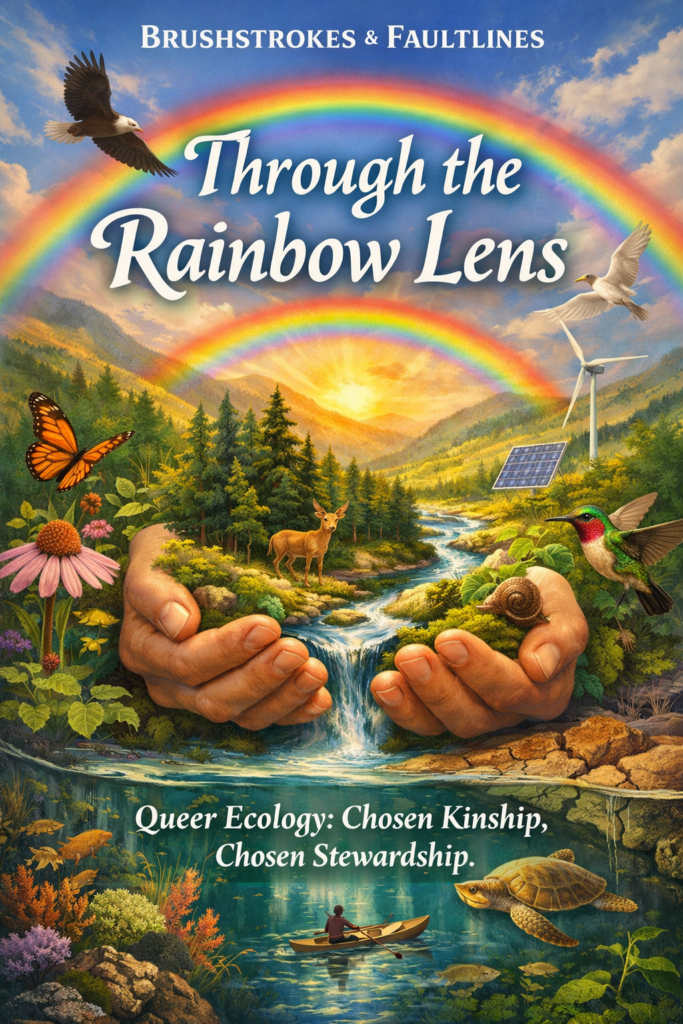
There are people who hear the word sacred and think immediately of a church, a text, a rulebook carried like a weapon. I understand that reflex. Many of us learned early that “sacred” could be used to lock doors, to bless cruelty, to call exclusion holy. And yet—out here, under the honest sky, in the simple work of keeping living things alive—sacred feels less like a sentence and more like a practice.
It is not complicated, at least not at first. Sacred is what you do when you are careful with what is not yours.
Queer people have always been fluent in that kind of care. We are, many of us, experts in building belonging without inheritance. We are practiced in making family without paperwork. We are the living proof that kinship is not only blood and permission—it is also choice, effort, tenderness, and the long labor of staying. We know what it means to find one another in the wilds of a world that would rather we disappear. We know how to create shelter with our bodies, our words, our time.
And that is where queer ecology begins: not as a slogan, but as a way of recognizing that the planet is also made of chosen relationships.
Because the natural world is not a straight line. It is not a tidy family tree with a single rightful branch. It is riotous, abundant, adaptive, and improvisational. It is symbiosis and strange alliances. It is fungi trading nutrients with trees. It is pollinators courting flowers with color. It is migration and metamorphosis and species learning new rhythms when old ones become impossible. Nature is not a narrow hallway; it’s a maze of doorways, a thousand ways of being alive.
So when people say “queer” like they mean “unnatural,” I look at a spring hillside erupting after rain, and I think: you have not been paying attention.
The idea that there is one correct way to live—one correct pairing, one correct family, one correct future—is the same myth that teaches us land is only valuable when it is useful. It is the same myth that turns rivers into pipes and forests into lumber and seas into extraction zones. It is the same myth that cannot bear complexity, cannot tolerate interdependence, and mistrusts anything it cannot own.
Queer life refutes that myth daily.
We don’t always do it gracefully. We are not saints. But we are often forced—by rejection, by distance, by necessity—to become artisans of community. We build mutual aid networks. We create food trains when someone is ill. We know how to pass along resources quietly when the world decides someone doesn’t deserve help. We become caregivers for friends, mentors for younger queer people, guardians of elders who have been discarded by their families. We learn how to make safety where no safety was offered.
That is stewardship.
And stewardship is the spiritual twin of conservation.
Conservation, at its best, is not about locking nature away from humans like a museum exhibit. It is about relationship. It is about humility. It is about choosing limits, again and again, even when greed offers a faster reward. It is about understanding that protection is not a mood—it is a set of behaviors. It is what you do with your money, your vote, your consumption, your attention. It is what you refuse to normalize. It is what you defend when no one is watching.
I think queer people understand sanctuaries in our bones. We have needed them.
Sanctuary is not only a place; it’s also a promise. It’s the unspoken contract that within these borders, you will not be hunted. Within this circle, you will be treated as real. Within this room, you will not have to audition for your own humanity.
Now apply that to an ecosystem.
A sanctuary for wildlife is a place where animals can move, mate, feed, nest, and migrate without being relentlessly interrupted by human appetite. A sanctuary for a river is clean water and unbroken flow and banks that can breathe. A sanctuary for a forest is a corridor wide enough that the genetic thread doesn’t snap. A sanctuary for a coast is not just a line on a map—it is enforcement, restraint, and the willingness to let the ocean remain an ocean.
We know what happens when sanctuaries become performative. We know what it looks like when someone claims to be safe and then turns on you the moment it becomes inconvenient. We know what it means to have “protected” spaces that quietly tolerate harm.
That’s why queer ecology cannot be satisfied with paper sanctuaries. We have lived too long inside the gap between language and reality.
So here is the question I want to place in the palm of the reader’s hand: what would it look like to treat land, water, and air the way we treat the people we love when they are vulnerable?
Not the way we treat them when it’s easy. The way we treat them when it costs us something.
It might mean paying more for food so that it isn’t grown at the expense of forests and wetlands. It might mean saying no to “cheap” products built on poisoned rivers and stolen labor. It might mean fewer flights and fewer conveniences and a stubborn devotion to reuse and repair. It might mean showing up at a county meeting to oppose development that cuts a corridor in half. It might mean donating to local land trusts, wildlife rescues, river cleanup organizations, indigenous-led stewardship groups, and climate justice networks that are doing the unglamorous work of keeping places alive.
It might mean using our queer skills—our hard-won creativity, our social intelligence, our ability to form community under pressure—to make conservation feel less like a lecture and more like a culture.
Because conservation, like queerness, is not only an identity. It’s a practice.
And practice requires repetition.
In queer community, we talk about chosen family as a kind of vow. Not a vow made once, but a vow renewed: I will show up. I will return. I will help you survive. I will not let the world convince me you are disposable.
What if we extended that vow outward?
To rivers and wetlands. To forests and grasslands. To species we will never touch with our hands but still owe our restraint. To the air itself, which enters our lungs without asking for our permission.
There is a grief that lives under all of this, and I don’t want to hide it. Many of us carry grief in our bodies—grief for lost time, lost safety, lost lovers, lost elders, lost ease. Ecological grief is not separate from that. It is the same muscle. It is the same ache: the knowledge that what should have been protected was not.
But grief can be a compass. It can be proof of devotion.
The world is not asking queer people to save it alone. The world is asking everyone to become less entitled. The world is asking for an end to the myth that only what is profitable is real. The world is asking us to conserve the sacred—not as performance, but as duty.
And duty does not mean joyless. Duty can be tenderness with teeth.
I have seen queer people plant gardens like prayers. I have seen us take broken spaces and make them livable. I have watched us turn ordinary kitchens into emergency relief. I have seen us throw our bodies between cruelty and the vulnerable, not because we are fearless, but because we know what it means to be targeted and we refuse to stand by.
That energy belongs in conservation.
Let our sanctuaries be real. Let them be enforced. Let them be defended even when the powerful complain. Let them be wide enough to hold migration, diversity, complexity, and the wild truth of being alive.
Spring is coming. That is not a guarantee. It is an invitation.
This month, I want us to treat the planet like chosen family: not because it is perfect, not because it has earned it, but because it is ours to protect—and because we know, better than most, what it means to need a place where you can simply exist without being destroyed.
–By Noble Osborn
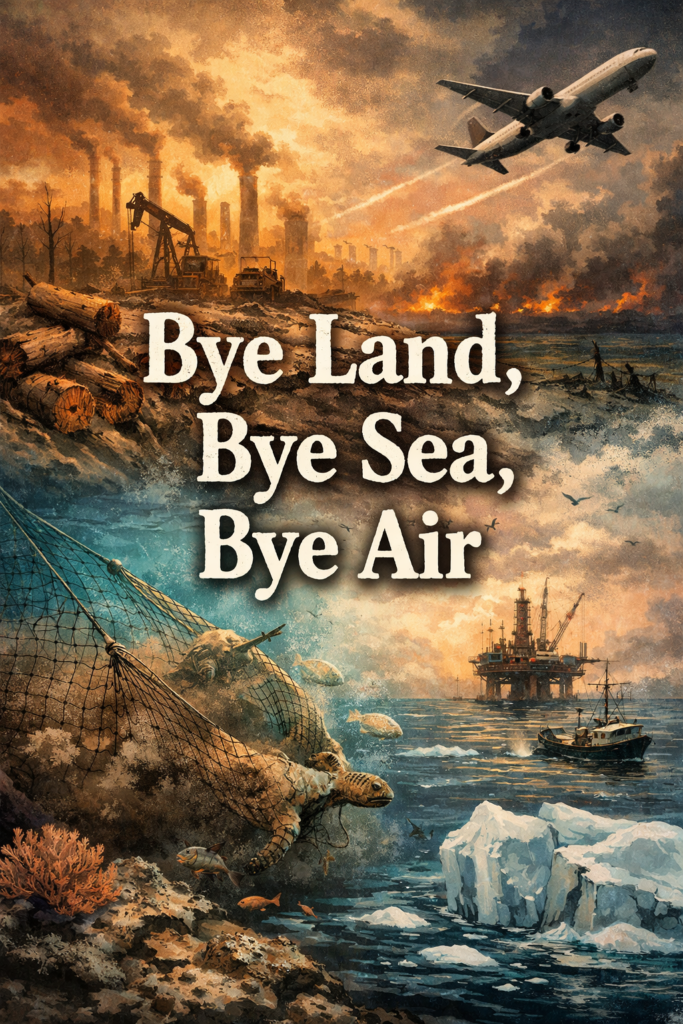
Sacred habitats under assault by global powers, and the quiet covenant we keep anyway
There are three goodbyes happening at once.
The first is said to the land: to forests that used to be thick enough to keep their own weather, to prairies that once held a thousand small miracles in the space between grasses, to mountains whose snowpack used to arrive like a vow and leave like a blessing.
The second is said to the sea: to seafloors scarred by nets dragged like rakes across ancient carbon and coral, to fisheries emptied faster than they can be counted, to coastlines forced to bargain with storms that no longer behave.
The third is said to the air: to the invisible commons we share without permission and poison without apology, to the atmosphere treated like a trash bin because it doesn’t come with a fence.
We are told to choose which goodbye matters most. We are offered a menu of losses, as if grief can be efficiently portioned: save the whales, or save the wetlands; protect the birds, or protect the boreal; fight the pipelines, or fight the trawlers; care about the Arctic, or care about the Amazon. But the violence is integrated. The assault is coordinated not by a single mastermind but by a shared philosophy: the sacred is only sacred until it becomes profitable.
And profit—when elevated to a god—always demands sacrifice.
The sacred isn’t sentimental. It’s structural.
“Sacred” is a word that makes modern power uncomfortable. It refuses to be optimized. It refuses to be reduced to a spreadsheet. It implies a boundary—an ethical line you do not cross even when you can, even when there’s money to be made, even when your rivals are crossing it with both boots on.
That is why the sacred must be mocked, diluted, or rebranded into harmless décor.
Call a forest a timber reserve.
Call a river a resource.
Call the ocean a frontier.
Call the atmosphere an externality.
If you rename a thing, you can reframe your betrayal as management.
But the old meaning persists beneath the new language: the sacred is what holds life together—what makes continuity possible. It’s not merely beauty, though beauty is often the first messenger. It’s the web itself: soil and fungi, pollinators and predators, currents and rainfall, seed banks and seasonal cues. When those systems are treated as expendable, you don’t just lose a place. You lose the conditions that allow any place to remain livable.
Sacredness, in this issue, is not churchy. It’s ecological. It is a moral recognition of dependency.
The land: when guardianship is replaced by extraction
The land teaches the oldest lesson: you cannot take endlessly without consequence. You can delay the accounting—redirect it, privatize it, export it—but you cannot erase it.
The land is where the slow crimes happen.
- A regulation is softened.
- A protected boundary is redrawn.
- A budget for enforcement is trimmed.
- A road is allowed “just this once.”
- A company promises restoration later.
- “Later” never arrives.
And then a forest becomes a patchwork of fragments. Animals lose corridors, then gene flow, then resilience. Springs dry. Fires move differently. Invasive species find their openings. What was once stable becomes twitchy and volatile.
The betrayal of the land is often sold as practicality: jobs, security, “responsible development.” But responsibility is measured by outcomes, not slogans. The land keeps receipts in the language of drought, collapse, and displacement.
The sacred duty here is not abstract: it is the refusal to turn living systems into liquidation events.
The sea: the seafloor is not a quarry
The ocean is the most misunderstood of the commons because it looks endless until it doesn’t. From shore, it appears to swallow our wrongdoing. But it does not dissolve it; it stores it.
The sea is where the fast crimes happen.
A trawler crosses a protected boundary at night.
A fleet fishes a region into hunger.
A reef is crushed and the damage disappears into depth.
A nation steals protein from another nation’s waters and calls it commerce.
The seafloor is not a quarry. It is habitat. It is carbon bank. It is nursery and archive. When we drag heavy gear across it, we don’t only catch fish—we damage the future of fish, and the stability of the larger system that makes fish possible at all.
And here is the deeper moral injury: the victims are often the people with the least power to object. Coastal communities, small-scale fishers, families whose food is literally the sea’s daily gift. The ocean becomes a battleground where wealth arrives with steel and satellite maps, and local hunger is treated as collateral.
Sacred duty, here, looks like enforcement, transparency, and the willingness to say: no one has the right to empty what everyone depends on.
The air: the invisible commons as a dumping ground
If the land is where you see the scars and the sea is where you pretend you can’t, the air is where harm becomes polite.
Nobody wants to look like the villain when the villainy is invisible.
The air is where the crimes are outsourced to “the system.” Where responsibility is divided until it disappears. Where a million small emissions become a crisis so large we call it inevitable. Where the future is made negotiable by people who will not live in it.
But the atmosphere is not a myth. It is not an abstraction. It is the shared membrane of life.
When we treat the sky as a landfill, we get what land and sea already understand: instability. Heat. Disruption. Cascades. The sacred is violated not by a single act of cruelty but by a normalized pattern: we keep taking from the commons as if the commons cannot be exhausted.
Sacred duty, here, is the hardest because it requires humility: we cannot buy our way out of physical reality.
Birds of a feather: power recognizes itself
Across land, sea, and air, you can watch a familiar choreography:
- Rule-breaking becomes a brand.
- Institutions are mocked until they can’t enforce boundaries.
- Science is treated as a political preference.
- Regulators are starved, captured, or intimidated.
- Communities are pitted against each other for scraps.
- “National interest” is used to justify private profit.
Call them “wannabe dictators,” call them strongmen, call them oligarchic regimes, call them cynical administrations, call them corporate-state alliances—the labels shift, but the pattern remains. These actors do not need a formal alliance to act in tandem. They only need to share one belief: limits are for other people.
And when enough powerful players agree that limits are optional, the sacred becomes defenseless unless ordinary people become guardians.
Which is, inconveniently, the oldest story.
A different kind of power: tradition, tenderness, and the refusal to betray
Not all forms of power destroy. Some forms protect.
A temple where animals are treated as neighbors rather than nuisances.
An indigenous community defending a river as kin.
A ranger network holding the line with too little funding and too much danger.
A fisher refusing destructive gear because the sea is their children’s inheritance.
A writer, a gardener, a teacher, a citizen—choosing not to cooperate with the lie that nothing can be done.
We do not romanticize these efforts. We honor them. Because they are not cute. They are costly.
Conservation is not a Hallmark movie. It is a discipline of restraint in a world addicted to taking. It is the daily, unglamorous labor of boundaries: saying no, enforcing no, living by no.
And yet the victories—when they come—prove something essential: repair is possible. Not guaranteed. Not quick. But possible.
What conserving the sacred asks of us
This issue has carried you from sanctuaries to scar tissue. Now the anchor asks one final question:
What will you refuse to betray?
Not as a performance. Not as a purity test. As a practice.
Here are the vows I offer, not as commandments, but as handholds:
- Name what is sacred in your own life.
A species. A place. A river. A patch of desert. A coastline. If you can name it, you can defend it. - Learn the threat in plain language.
Who profits? What policy allows it? Where is enforcement failing? What is being quietly normalized? - Support the people who hold the line.
Local conservation groups. Indigenous stewardship efforts. Legal defense funds. Community science. Habitat restoration. Small-scale fishers fighting industrial theft. - Make one political act and one daily act.
Politics without daily practice becomes theater. Daily practice without politics becomes a hobby. The sacred needs both. - Refuse despair as an excuse.
Despair is understandable. But despair can also be a convenient alibi for people who want the destruction to proceed unchallenged.
The ending is not written, but the covenant can be
“Bye land, bye sea, bye air” reads like a lament, and it is. But it is also a warning flare. A reminder that the commons is not automatic. It survives only if we treat it as sacred—meaning: not for sale, not for sacrifice, not for conquest.
Spring is coming. Spring always comes, until it doesn’t.
Let this be the season where we stop speaking goodbye as if it is destiny.
Let it be the season where we speak guardianship as if it is a role we are finally ready to claim.
Because the sacred does not need our admiration.
It needs our defense.
–By Noble OSborn