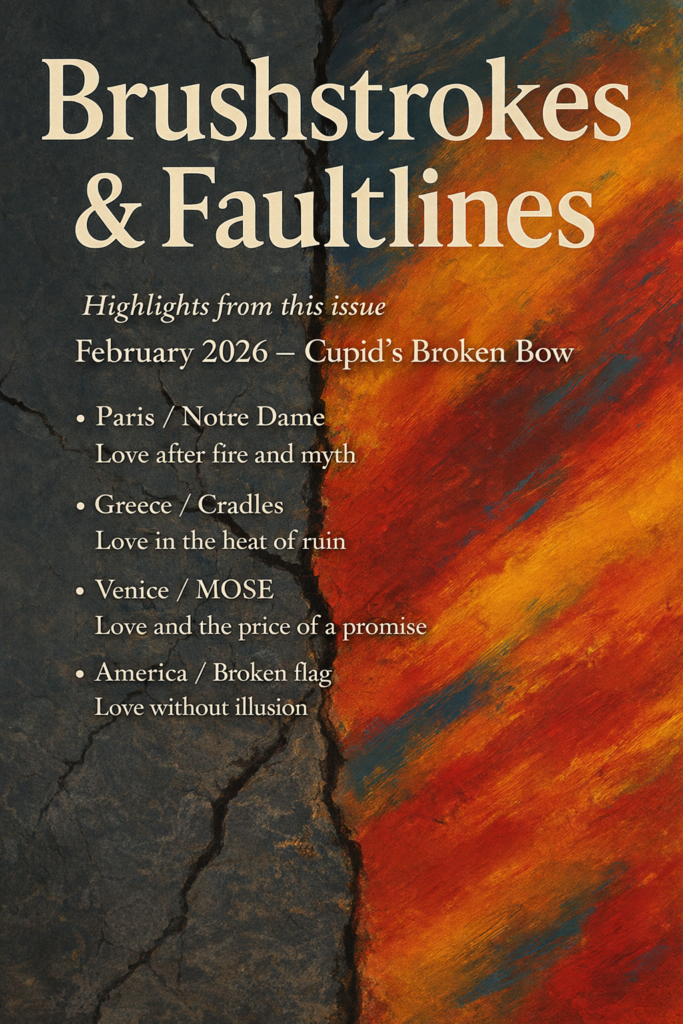
Table of Contents
- Letter From the Editor: Cupid’s Broken Bow
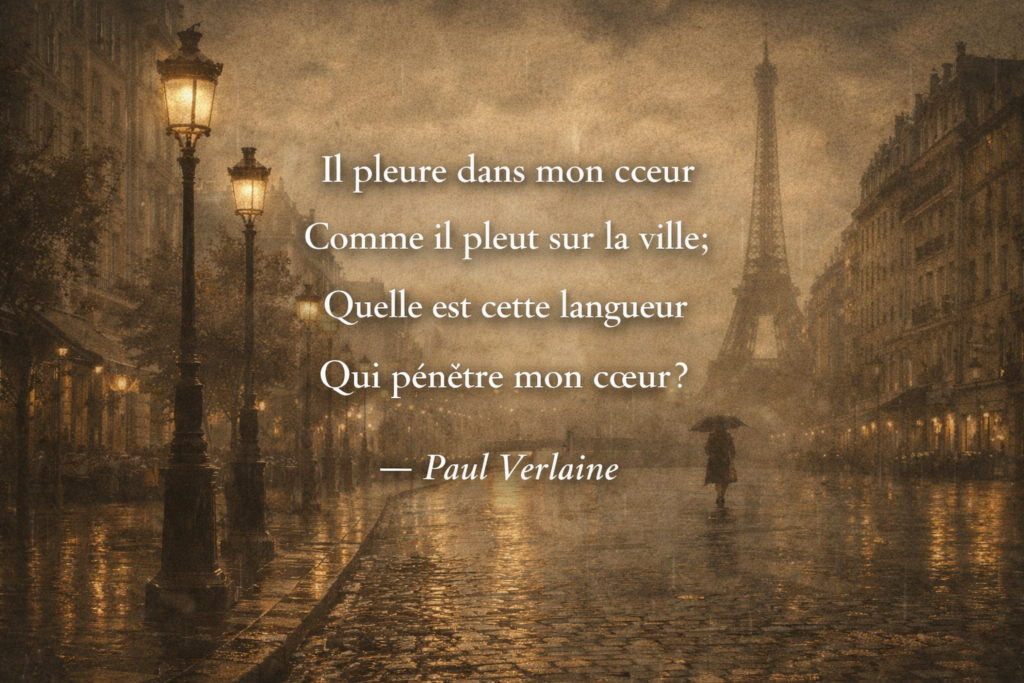
- Interlude: French (Verlaine)
- An Pari! The City of Light Going Dark
- Notre Dame After the Fire, After the Myth
- Interlude: Italian (Petrarch)
- Ashes of a Cradle
- Eros vs. Cupid (And Why the Bow Breaks)
- Venice — The Drowning Lover
- MOSE and the Price of a Promised Rescue
- Interlude: Greek (Pindar)
- America — The Broken Dream
- Through the Rainbow Lens: The Queer Geography of Disillusionment
- Interlude: American (Dickinson)
- Cupid’s Broken Bow: A Brief Field Guide to Disillusionment
- Falling Out of Love With Places (And What Comes After)
- Reflections in Verse: Cupid’s Broken Bow
Letter From the Editor — Cupid’s Broken Bow
Every February, the world tries to hand us romance on schedule: soft-focus cities, candlelit myths, love that arrives clean and stays that way. But this year’s theme isn’t love as a promise. It’s love as a lesson.
Cupid’s broken bow is about the things that sounded great at first — the grand fixes, the comforting stories, the “we’ve got it handled” assurances — and then fell apart in the weather, in the politics, in the fine print. It’s about the projects and policies that were supposed to protect what we adore, only to reveal what we were willing to ignore.
Take Venice. MOSE was a dream with a ribbon-cutting future: a mechanism to keep the water where it belonged, a guarantee that beauty could remain undisturbed. It felt right because we wanted it to be right. But a plan can be technically brilliant and still spiritually dishonest — not because of engineering alone, but because of the human ecosystem around it: corruption, delay, overselling, the temptation to treat nature as a negotiable inconvenience. In that sense, MOSE isn’t only a sea-defense story. It’s a parable for this entire issue: the moment when the romance of certainty gives way to the reality of consequence.
That’s what I keep circling back to: the places we once loved are still there, but they are not the same places anymore — and neither are we.
Paris is an easy shorthand for romance and enlightenment, a city we’ve been trained to “love” before we’ve even learned its neighborhoods. Yet the City of Light has been living under darker lamps for a long time now: political tension, social unease, and a constant churn of disillusionment that shows up in the most ordinary ways — strikes, standoffs, a population that is tired of being told to smile for the postcard. Even the culture that once felt untouchable has been touched by anxiety and opportunism; the headlines don’t let you forget that symbols can be targeted, that institutions can be strained, that prestige isn’t protection.
There’s an old French quip about the absurdity of governing a people with hundreds of kinds of cheese — a joke about abundance and personality and friction. But the laughter has changed timbre in the last quarter-century. Pluralism used to read as charm. Now, under pressure, it can be framed as chaos. Democracy used to feel like a love story. Now it’s increasingly sold as a brand — defended like a possession, invoked like a spell, and too often treated as something that exists automatically rather than something that must be renewed.
Greece carries that same ache in a different register. When the Acropolis closes because the heat is too severe — when a civilization’s most iconic monument has to step back from the sun — it’s hard not to feel the symbolism land in your body. This isn’t just “climate” as an abstract warning. It’s climate as a hand on the shoulder, turning you toward a truth you’d rather not face: history can be overwhelmed. Myth can be scorched. A place that has always stood for endurance can still be made to pause.
And America, in its own way, is another version of the same heartbreak. We’ve been raised on national romance: shining city, endless horizon, the moral arc, the promise that if you believe hard enough the system will become what it claims to be. But romance curdles when the beloved refuses to change, when violence becomes familiar, when competence becomes optional, when the environment is treated as background noise instead of the stage itself. Falling out of love with a national myth is disorienting, not because you stop caring, but because you realize how much of your imagination was invested in a story you didn’t write.
This is the thread connecting Venice, Paris, Greece, and America: love that burns bright and then burns out — not because love was foolish, but because the object of devotion demanded blindness.
That’s what we’re refusing this month: the comfortable blindness.
Cupid’s Broken Bow is an invitation to look past the glitz and glamour of the brochure and the sparkle of lights — and to see places as they really are, not as their regimes, their tourist economies, or their nostalgic storytellers insist they must be. Not to sneer at them. Not to punish them. But to love them with adult eyes.
Adult love doesn’t require denial. It requires attention.
It’s also why I’m keeping the politics at a steady, honest temperature. Not cold. Not overheated. Just clear. Because the romance of national myth and democracy is powerful — it shapes cities, it shapes policy, it shapes what gets protected and what gets sacrificed. Over the last twenty-five years, we’ve watched how quickly ideals can be repackaged, how easily “heritage” becomes a shield against accountability, how often spectacle is offered in place of a plan. We’ve watched how infrastructure projects become salvation stories until the bill comes due. We’ve watched how “stability” becomes the excuse to accept less and less of what we were promised.
And still — I’m not writing this as a farewell letter to the world.
I want this issue to leave you with sobering clarity, yes. But also renewed curiosity: the kind of curiosity that doesn’t ask, “How do I get the perfect photo?” but instead asks, “What is this place trying to survive?” The kind of curiosity that listens more than it performs. The kind that notices who is being pushed out, who is being priced out, who is being burned out. The kind that understands the difference between a city as a fantasy and a city as a living, aching, complicated home.
If Cupid’s bow is broken, maybe it’s because we’ve been aiming at the wrong targets. Maybe the point isn’t to “fall back in love” with the myth. Maybe the point is to choose a deeper attachment — not to the sparkle, but to the truth. Not to the brand, but to the people. Not to the promise as marketing, but to the promise as responsibility.
That’s the work of this month. Not to abandon love — but to rebuild it without illusions.
In the Fractures, Finding Light,
Noble
An Pari! The City of Light Going Dark
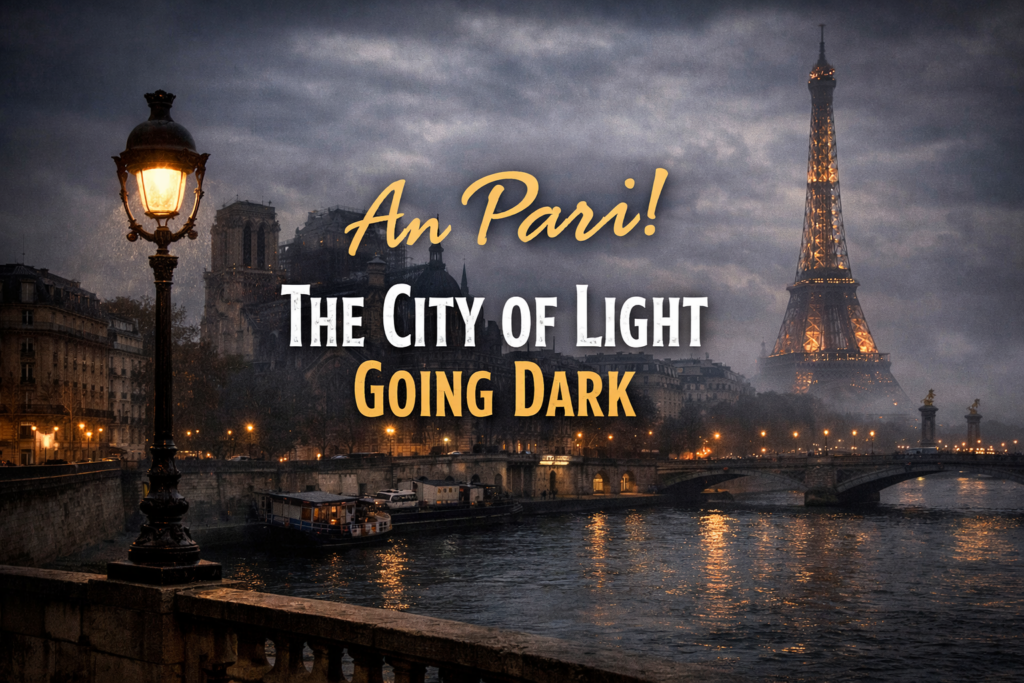
Paris is one of the few places on earth that arrives in the imagination before it arrives in the body. Long before you’ve learned its neighborhoods, its rhythms, its ordinary mornings, you’ve already been taught the shorthand: lamplight on the Seine, cafés at dusk, a skyline that seems to promise meaning. Paris is not simply a city in the public mind. It is a symbol, an export, a form of lighting.
That’s why “the City of Light” is such a powerful myth. It doesn’t only describe what Paris looks like at night. It implies a kind of moral illumination: enlightenment, culture, elegance, reason. It suggests that to be near Paris is to be near something that makes the world clearer.
But myths are expensive to maintain, and Paris has been paying the bill in ways that are harder to romanticize. The question isn’t whether Paris has “fallen,” as if cities were saints. The question is what becomes visible when a place that has been asked to shine for centuries starts to flicker. What happens when the light is still there, but it no longer feels like a promise?
Paris is not ruined. Paris is revealed.
The romance industry teaches us to love Paris in advance. It hands us a version of the city that is always ready for the photograph and always fluent in charm. It tells us where to look and how to feel. It trains the visitor to consume a city like a mood: a weekend of glow, a handful of icons, a story you can take home. In that transaction, “Paris” becomes a brand as much as a place, and brands do not tolerate complexity. Brands do not want labor disputes or crowded hospitals or political ugliness. Brands do not want heat waves. Brands want lighting.
Yet cities are not brands. Cities are systems. They are bodies made of work.
If you want the clearest metaphor for this moment in Paris, you don’t need to hunt for it. It’s already there in stone, soot, and scaffolding. Notre Dame did not burn as a private tragedy. It burned as a public symbol, a flare shot into the night over a city that has always believed itself permanent. The fire was an interruption in the story Paris tells about itself. It was a reminder that even the most protected icons are not protected from physics, accident, maintenance failures, human error, or time.
The rebuild has become its own drama. It can be read as resilience, and it can also be read as performance. That is the tension Paris is living in right now: the desire to restore the image versus the harder task of restoring the conditions that allow a city to be livable. A cathedral can be rebuilt with exquisite care, but “authenticity” is not something you can simply reconstruct on schedule. Authenticity is a relationship between people and place, and relationships require honesty.
There’s another reason Notre Dame is such a potent emblem for this issue’s theme: fire changes the meaning of what survives. After a burn, you don’t return to the “before.” You return to the “after,” and you have to learn how to love what remains without insisting it pretend to be the untouched original. That is the kind of love we rarely practice with cities. We demand that places stay exactly as they were when we first believed in them. We demand they remain faithful to our fantasy.
Paris, for a long time, has been rewarded for feeding fantasy.
But the fantasy has begun to fail, not only because Paris has changed, but because the world has changed. Political fracture is no longer a distant rumor humming beneath the tourist soundtrack. Social unrest is no longer an occasional disruption that can be edited out of the story. The city’s tensions show up in public life and private life, in the street and the subway, in the price of an apartment and the strain on the people who keep the machinery running.
Strikes are one of the clearest expressions of this strain. In the tourist imagination, a strike is an inconvenience, a detail that disrupts the itinerary. In the civic reality of Paris, a strike is a language. It is a way a city speaks when it believes it is not being heard. It is a form of negotiation made visible: workers insisting that dignity is not optional, that wages matter, that time matters, that life is not an accessory to the city’s beauty.
And when those strikes become frequent, when they appear as recurring waves instead of rare events, they signal something deeper than a scheduling problem. They signal a city arguing with itself about its future, and a population increasingly unwilling to participate in the illusion that everything is fine. A city can be luminous on the outside and exhausted on the inside.
There’s an old line, often attributed to Charles de Gaulle, about the impossibility of governing a country with hundreds of varieties of cheese. It’s meant as a joke about abundance and stubborn individuality, about how France is too richly itself to be easily managed. Once, that line played like affection. Now it lands differently: not as charm, but as a question about governability in an era of pressure. When complexity is treated as chaos, when difference is treated as dysfunction, when frustration becomes fuel for hard-edged politics, the joke loses its softness.
Paris, like many major capitals, sits at the intersection of competing stories about what a nation is and what it should become. Those stories have become sharper in the last quarter-century. The romance of democracy has increasingly been marketed like a product: invoked as a heritage item rather than practiced as a daily discipline. In that climate, the city becomes a stage where identity battles, security anxieties, and ideological tensions play out in public. The light changes color. It becomes less about illumination and more about surveillance. Less about openness and more about control.
This is what “going dark” can mean without ever losing a single streetlamp.
And then there is the literal pressure that turns metaphor into weather.
Climate is not a future theme in Paris. It is already present in heat, infrastructure stress, and the growing sense that seasons do not behave as they used to. A city built to charm the senses also depends on a delicate balance of systems: transportation, energy, water, public health. When heat intensifies, when extreme conditions become more frequent, those systems have to work harder. The city’s glow becomes more expensive. The lived experience of summer changes. The body of the city carries strain.
There is a particular sadness in watching a place known for its atmosphere confront the fact that atmosphere is no longer stable.
Paris has always been a lesson in how much human life relies on engineering disguised as elegance: the bridges, the boulevards, the waterlines, the transit arteries that keep a dense city moving. But we are entering an era where the old assumptions behind those systems are being rewritten. The romance of permanence runs into the reality of adaptation. The brochure does not include maintenance. The myth does not include heat.
None of this is unique to Paris, which is precisely the point. Paris is simply a highly visible version of a broader phenomenon: the collapse of comfort-stories. Across the world, we are falling out of love with places and promises not because they have stopped being beautiful, but because beauty can no longer hide the costs of denial. We are watching icons become vulnerable, institutions become strained, politics become harsher, and weather become more uncompromising. We are watching the mismatch widen between the story we were sold and the conditions we inhabit.
So what do we do with Paris in the middle of that shift?
We can begin by refusing the easy posture: either cynicism or nostalgia. Cynicism is the lazy sibling of heartbreak. Nostalgia is heartbreak pretending it can travel backward. Neither is love.
A better approach is adult attention.
To visit Paris differently, in the spirit of this issue, is not to hunt for darkness like a scavenger. It is to look beyond the tourist lighting and ask what makes a city livable. Who cleans it. Who drives it. Who teaches in it. Who is priced out of it. Who is protected and who is not. How it governs itself under strain. How it absorbs shock. How it holds its contradictions without turning them into scapegoats.
It is also to recognize that romantic attachment to a place can be a form of blindness. If we “love” Paris only as an idea, we will defend the idea even when it harms the reality. We will protect the image instead of the people. We will treat critique as betrayal. We will demand that the city remain a museum of our own longing.
But cities are living. They age. They change. They suffer. They adapt. They reveal.
Paris still glows. It still seduces. It still moves like a poem when the light hits right. But perhaps its truest illumination now is not the glow that flatters the traveler. Perhaps the new light is the one that shows the machinery: the civic disputes, the labor realities, the political tensions, the climate pressures, the rebuilding after rupture.
The City of Light is not going dark because it has lost its bulbs. It is going dark because it is becoming harder to pretend that light is the same thing as clarity.
And clarity is what this issue asks for.
Not a breakup letter. Not a condemnation. A reckoning. A shift from brochure-love to honest relationship. A willingness to see a beloved place for what it is, not what it once promised to be.
If Cupid’s bow is broken, the question becomes: what replaces the cheap arrows of fantasy? What replaces the quick infatuation with icons?
Maybe the answer is a slower kind of devotion. The kind that can survive disappointment. The kind that keeps looking even when the lighting changes. The kind that understands that love is not the absence of fracture, but the choice to see fracture clearly and still care what happens next.
Paris does not need us to pretend it is untouched. It needs us to stop demanding performance and start noticing reality. It needs us to love it like a place where people live, not like a stage set built for our longing.
That is how the light returns: not as a myth, but as a practice.
Notre Dame After the Fire, After the Myth
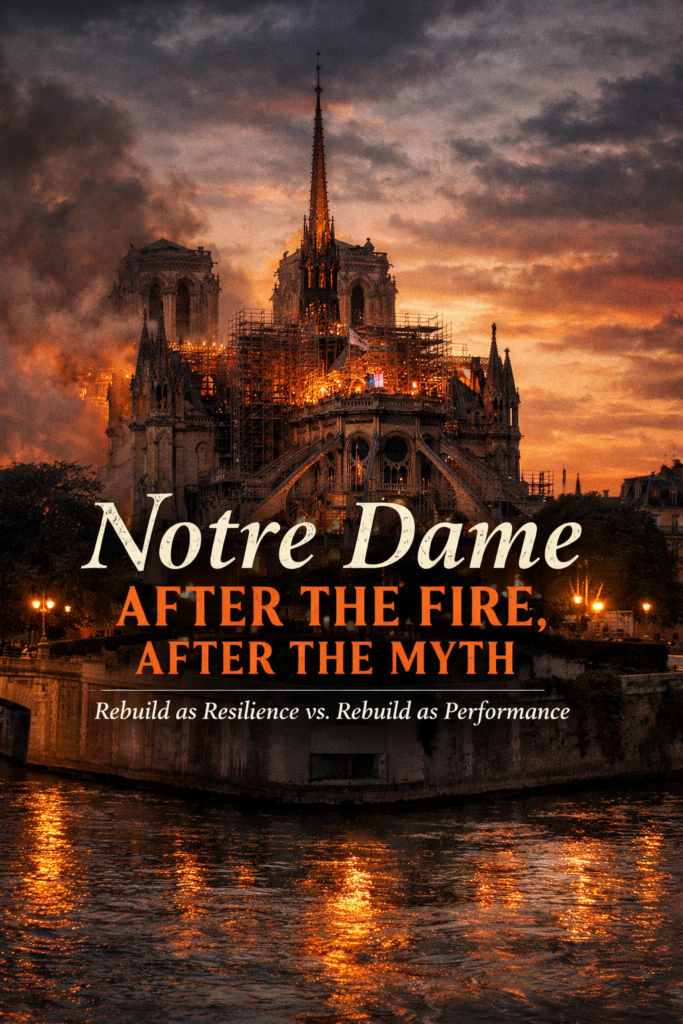
For a long time, Notre Dame belonged to that category of things we treat as permanent. Not eternal in the religious sense, not immortal in a literal one — permanent in the way a symbol becomes so woven into the mental landscape that it stops feeling like architecture and starts feeling like a law of nature. It is simply there. It will always be there. It is Paris made visible.
Then, in the bright cruelty of television and phone screens, it burned.
The shock wasn’t only grief for a building. It was the jolt of watching a shared certainty turn mortal. Fire has a way of stripping illusion down to its bone: stone can crack, beams can collapse, history can be reduced to smoke. And in that moment, something else became visible too — how much of Paris we have been loving as myth.
Notre Dame is a cathedral, yes. But it is also a national emblem, a cultural relic, a tourist magnet, a cinematic shorthand, a kept promise of “old world” grandeur. In the modern imagination, it stands for a kind of continuity that people crave: an assurance that beauty will remain where beauty has always been. That is why the fire traveled so quickly through the world’s nervous system. It was not just Paris losing something. It was the entire romance economy losing a pillar.
When a symbol holds that much collective projection, rebuilding is never only a matter of stone and timber. It becomes a referendum on meaning. Whose Notre Dame is being restored? The believer’s? The historian’s? The artisan’s? The politician’s? The tourist’s? The nation’s? The world’s?
Under that pressure, “authenticity” becomes the most contested word in the room.
People invoke authenticity as if it is a single, obvious standard — but in moments like this, it fractures into competing meanings. There is material authenticity: the original fabric, the original marks of time, the physical continuity of what was. There is visual authenticity: the desire for it to look the way we remember, to restore the familiar silhouette and the comfort it delivers. And there is narrative authenticity: the story a society wants to tell about itself through the act of rebuilding — resilience, faith, continuity, triumph over loss.
Those forms of authenticity do not always align. Sometimes the truest restoration of materials alters the appearance. Sometimes the most comforting appearance requires replacement, replication, and modern intervention. Sometimes the “story” demanded by politics, donors, or public hunger overwhelms both craft and patience. Authenticity, in other words, is not a simple measurement. It is a relationship with time — and time was broken that night.
Still, it would be dishonest to write about Notre Dame’s restoration with only skepticism. There is a real and noble version of rebuilding: a society gathering itself to repair what it loves. To rebuild a cathedral is to declare that loss is not the final authority. It is to practice continuity as a civic ritual. It is to give artisanship and care a public stage — not as spectacle, but as devotion. Repair can be a form of love that does not depend on perfection.
In that sense, restoration can be resilience. The work itself becomes a kind of collective vow: we will not surrender our inheritance to ash, we will not let grief make us passive, we will return with tools and patience and begin again.
But there is another truth running alongside it, and it deserves equal honesty: rebuilding can also become performance.
Modern life is saturated with staged reassurance. We are offered “back to normal” as a product, and normal as an anesthetic. When something beloved breaks, institutions often rush toward the comfort of completion — not because completion is wise, but because it photographs well. A rebuilt symbol can become a political trophy, a donor narrative, a brand-repair campaign. The danger is not rebuilding itself; the danger is rebuilding the image while leaving the underlying fractures untouched.
This is the moment where Notre Dame becomes more than a cathedral. It becomes a mirror.
Because the fire did not happen in a vacuum. Paris, like so many places held up as an emblem, has been carrying layered strains: social disillusionment, public frustration with working conditions and cost of living, recurring unrest that isn’t merely “noise” but a symptom. The City of Light is still luminous, but the meaning of that light has changed. Some of it is theatrical now — a glow that insists everything is fine, even when the civic mood says otherwise.
In such a context, the restoration of a cathedral can operate as a kind of cultural compensation: if the symbol can be made whole, perhaps we can feel whole. If the skyline can be repaired, perhaps the story can be repaired. If Notre Dame can stand again, perhaps Paris can remain the Paris of our imagination.
And this is where the question of authenticity sharpens into its real edge: what exactly are we restoring when we restore a symbol?
It is possible — and perhaps unavoidable — that both stories are true at once. The restoration can be sincere and still become a stage. The craftspeople can be devoted even as the political class turns the project into a statement. The public can genuinely hunger for continuity while also craving an easy relief from deeper anxieties. A rebuilt cathedral can be a triumph of human care, and still be used as a curtain.
Holding those contradictions is part of what this issue is asking us to practice: adult attention. Not the attention that seeks a clean answer, but the attention that stays awake to multiple truths.
That is why Notre Dame belongs inside Cupid’s Broken Bow. Because “broken” is not only about failure — it’s about revelation. When a bow breaks, you finally see what it was made of, and what you were asking it to do. In our romantic relationships with cities, we often ask for too much: for places to remain unchanged, for symbols to protect us from uncertainty, for heritage to guarantee stability. We aim love like a certainty. Then reality arrives — heat, conflict, strain, the weight of time — and the aim no longer holds.
Paris will continue to glow. It will continue to draw pilgrims and lovers, artists and tourists, believers and unbelievers. Notre Dame will stand again, and the sight of it will move people. But if we want the light to mean more than performance, we have to learn a different kind of devotion — one that does not require denial.
To visit a rebuilt symbol honestly is to do something more demanding than admire it. It is to treat restoration not as a happy ending, but as a beginning. It is to look beyond the photograph and ask: who maintains this beauty? Who is asked to keep the city running? Who can afford to live in the story, and who is priced out of it? What systems are being repaired alongside the stone, and which ones remain neglected?
The brochure version of Paris asks only for awe. The adult version asks for attention.
Notre Dame after the fire is not only a cathedral restored. It is a lesson in what happens when myth meets mortality. It reminds us that permanence is an agreement, not a guarantee. It reminds us that authenticity is not a look, but a commitment to the truth of what has been lost and what must still be faced.
If we can accept that, then the rebuilding does not have to be an illusion. It can be something rarer: a public act of care that doesn’t pretend the world is unbroken. A symbol repaired without insisting that repair is the same as redemption.
And maybe that is the most hopeful thing a fractured age can offer: not the promise that nothing will burn, but the proof that even after fire, we can choose to rebuild with open eyes.
Ashes of a Cradle
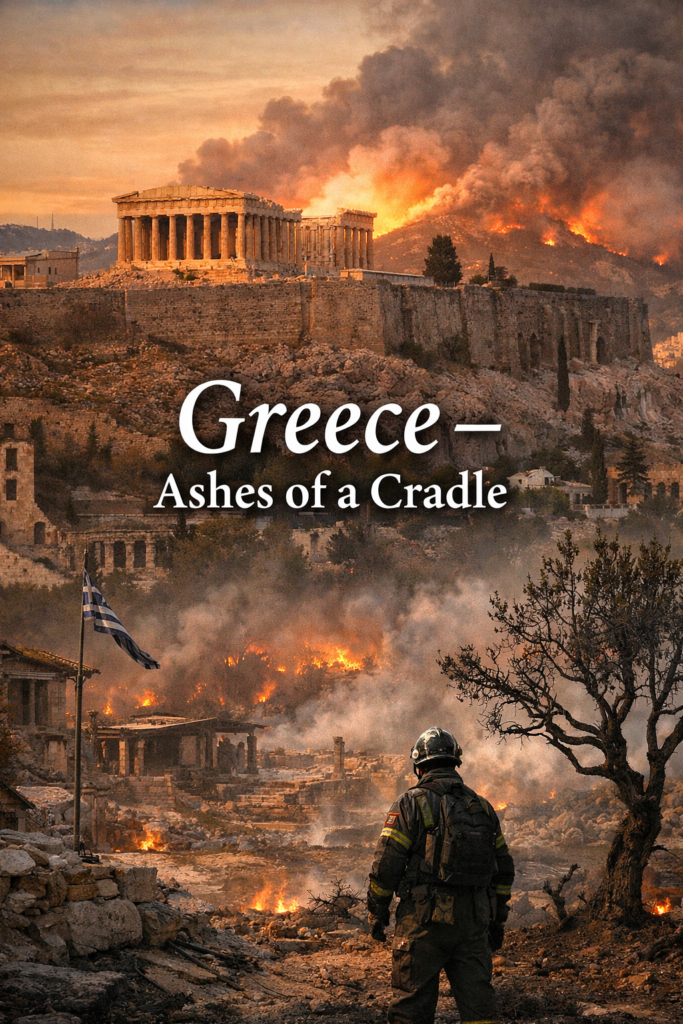
There are summers now when the Acropolis closes because the heat is too severe.
That sentence lands like prophecy even if you read it as ordinary public safety. The hill that has watched empires rise and break, the stone that has outlived kings and committees, stepping back from the sun—closing its gates not for war, not for plague, but for temperature. It is a small administrative act with an enormous symbolic shadow. It is history itself taking shelter.
Greece has always been loved as an origin story. We speak its name as shorthand for beginnings—democracy, philosophy, theater, the idea that public life can be argued into something resembling truth. We “love” Greece not only for what it is, but for what we have decided it represents: a cradle where the West was rocked into consciousness, a coastline where beauty and mind were born together.
But this issue is about the moment love changes—when admiration can no longer survive on glow alone, when the romance of a place begins to fail under conditions that romance was never built to endure.
Cupid’s broken bow is not only about heartbreak. It’s about promises that sounded right at first—plans, myths, assurances—and then fell apart when reality asked to see the receipts.
In Greece, the bow breaks in plain sight: in heat strong enough to stop the pilgrimage to the Parthenon, in fire seasons that return with the steadiness of ritual, and in the long aftertaste of austerity that taught a modern nation what it feels like to be told, year after year, to do more with less until “less” becomes the only thing you have left to offer.
To talk about Greece as ashes is not to insult it. It is to tell the truth about a place that has become a mirror for the age we’re living in: an age where the past is revered, the present is strained, and the future arrives as weather.
The Cradle and the Burden
The trouble with cradles is that we don’t like to imagine them burning.
We place a cradle in a room of soft light. We associate it with safety and beginning, with the reassurance that something new can be protected while it grows. When we call Greece a cradle, we are not describing its current conditions. We are describing our relationship to it. We are describing a devotion that expects stability because the symbol feels too important to fail.
But symbols are not shields. They don’t block heat. They don’t stop smoke. They don’t fund fire departments. They don’t maintain roads or salaries or the invisible systems that allow daily life to hold.
The romance of Greece has always been myth-heavy. We like our Greece marble-white and sun-warmed, draped in bougainvillea and framed in blue. We like it as a lesson: the birthplace of democracy, the home of gods and tragedy, the stage where civilization learned to speak in public.
What we do not like is Greece as a country—ordinary, modern, stressed, politically complicated, and painfully exposed to the same forces reshaping everything else: economics that demand sacrifice, climate that demands adaptation, and global appetites that demand performance.
And perhaps that is the first fracture to name: loving Greece as a story is easy. Loving Greece as a living place—one with limits, labor, budgets, and bodies—is harder.
Austerity and the Taste of Exhaustion
No one needs another lecture about the Eurozone crisis to understand what austerity does to a nation’s nervous system.
Austerity is not just a spreadsheet. It is a cultural posture forced into the bones. It teaches a public to expect less—from institutions, from leadership, from the future. It corrodes trust not only in politicians, but in the idea that the social contract has meaning.
A decade of cuts and pressure leaves marks that don’t vanish when the headlines move on. You feel it in the way infrastructure ages. You feel it in wages that don’t catch up to reality. You feel it in the quiet mathematics of public readiness: what happens to staffing, equipment, maintenance, and morale when “efficiency” becomes the only virtue allowed.
When a society is told, repeatedly, that survival is a matter of compliance—tighten your belt, accept the pain, endure—something else tightens too. People learn to live in a constant low-grade emergency. They become good at improvisation and tired of being grateful for it.
Then climate arrives, not as metaphor but as force, and the question becomes uncomfortably practical: how does a country respond to recurring disasters when the muscle memory of scarcity has already been trained into the system?
Ash and Season
Fire has always been part of the Mediterranean imagination. There is a reason the ancient world gave fire a god and not merely a tool. Fire is creation and destruction, warmth and weapon, ritual and catastrophe. It is sacred and indifferent.
But the modern fire season is different. It is not a sudden tragedy that interrupts the year. It is an expected chapter. It returns often enough to feel like a calendar has been rewritten.
When hills burn, it is not only trees that vanish. It is shade. It is soil stability. It is the slow work of an ecosystem that took decades to become itself. It is the boundary between “this is a beautiful place” and “this is a vulnerable one” collapsing in real time.
And once a place becomes a recurring emergency, romance becomes irresponsible.
The world will still post the photographs—white villages, sunsets, island harbors. But smoke has a way of making the truth visible even when people look away. Fire is not simply a natural event. It is a political stress test. It asks whether prevention was funded, whether land was managed, whether warnings were trusted, whether evacuation systems function, whether recovery is real or cosmetic.
Fire also reveals the cruelty of romantic distance. Outsiders grieve the view. Residents grieve their lives. When we love Greece as scenery, we mourn the aesthetic. When we love Greece as a place where people live, we mourn a system being pushed past its capacity.
Heat as Governance
The Acropolis closures matter not because tourists are inconvenienced, but because heat is now a governing force.
Heat determines work hours. It determines health outcomes. It determines whether public spaces can be safely occupied and whether ancient stone becomes a hazard. It determines whether the city can keep its lights on without strain. It determines whether the very act of movement—walking, visiting, gathering—can occur without risking collapse.
This is not a poetic complaint. It is policy pressure.
When the sun becomes dangerous, the day changes shape. When the day changes shape, the economy changes shape. When the economy changes shape, everything that depends on predictable seasons begins to tremble.
And there is a particular cruelty in the way heat exposes inequalities. People who can retreat indoors, who have cooling, who can shift schedules, suffer less. People whose labor is physical, public, or low-paid carry the risk. Heat turns the city into a hierarchy you can feel on your skin.
If democracy is the idea that a public shares conditions and responsibilities, then heat is one of the harshest questions a modern democracy can face: how do you protect bodies when the environment itself becomes an adversary?
The Gods Still Fit
It can feel indulgent to reach for Greek gods when modern problems are already severe. But the ancient vocabulary persists because it names what we keep repeating: elemental forces, human pride, systems that punish denial.
Hephaestus, the god of the forge, is useful here—not because Greece is mythical, but because the country is being forged again under heat and fire. A forge is a place where something is reshaped by temperature and pressure. Not everything that enters the forge survives intact. What emerges is changed.
Poseidon belongs in the background too. Greece is sea-wrapped—its islands and coastlines are part of its beauty and part of its vulnerability. The sea brings trade, travel, and romance. It also brings storms, erosion, and rising lines that do not negotiate with nostalgia. Coastal love stories always come with the knowledge that the tide keeps its own schedule.
And Athena—the symbol of wisdom and the city—reminds us that intelligence is not the same as preparedness. Wisdom is not merely knowing what’s happening. Wisdom is acting in time. It is investing before the crisis, not only lamenting after it. It is telling the truth to your own people without turning truth into panic or performance.
If the gods still fit, it’s because the human story hasn’t changed: we keep building lives in partnership with forces we do not control, and then acting surprised when those forces demand respect.
The Brochure Love and the Real Love
Tourism is not evil. But it is a kind of romance industry: it sells the promise that you can enter a place, consume its beauty, and leave with a story that belongs to you.
Greece is one of the world’s most intensely romanticized destinations, which means it is one of the places most pressured to perform itself. The blue-domed fantasy is not just an image. It is an economic expectation. It shapes infrastructure. It shapes policy. It shapes how a country is asked to present its own reality.
The problem is that performance requires stability.
When heat becomes routine, when fires return, when water and energy systems are strained, a place can no longer perform the same way. The fantasy becomes harder to sell without lying. The lie becomes harder to maintain without resentment. And resentment is a kind of smoke: it seeps into everything.
This is where Cupid’s broken bow becomes instructive. The “love” the world has for Greece—often sincere, sometimes shallow—cannot survive unchanged. Not because Greece is less beautiful, but because beauty is no longer the only story. Conditions have changed. Costs have changed. The moral responsibilities of visiting and admiring have changed.
To fall out of love with a fantasy is not betrayal. It is the beginning of an honest relationship.
How to Visit Differently
If this issue offers an invitation, it is this: visit places differently.
Look beyond the glitz and glamour of the brochure and the sparkle of lights. That sparkle is real, but it is not the whole truth, and it is not free. Someone maintains it. Someone cleans it. Someone absorbs its costs.
To visit differently is not to arrive as a critic. It is to arrive as a witness.
It means noticing the schedule shifts and the closed gates and the shaded hours, not as inconveniences but as signals. It means seeing labor not as background but as the structure that holds the experience up. It means asking what climate adaptation looks like on the ground: where shade is added, where water is conserved, where public safety is prioritized, where the city is trying—quietly—to become livable under new rules.
It also means resisting the urge to turn Greece into either a paradise or a cautionary tale. Both are simplifications. Greece is a place with fierce beauty and fierce strain. A place that has already survived more than our fantasies can handle. A place learning, like the rest of us, what it means to live inside a changing climate and an exhausted political era.
The Cradle Is Not Burning Because It Is Weak
There is a temptation, when you see a symbol strained, to assume the symbol is collapsing. But the Acropolis closing for heat is not weakness. It is adaptation. It is care. It is a body—collective, civic—choosing not to sacrifice itself for spectacle.
And that choice is worth honoring.
The true tragedy would be to keep pretending nothing has changed, to keep selling the myth at full brightness while the real world overheats behind the curtain. The true tragedy would be to demand that Greece remain a postcard so the rest of us don’t have to feel what the future is already doing.
If Greece is a cradle, let it also be a warning—and a lesson. Not that democracy is doomed, but that democracy is physical. It exists in public systems, worker protections, emergency response, energy decisions, and the willingness to tell the truth even when truth costs votes.
This is the kind of love Cupid’s broken bow is trying to teach: love that doesn’t demand denial. Love that can survive the sight of ash. Love that learns to aim again.
Because even in a country of ruins, there is still the possibility of repair—not the glossy repair that tries to look untouched, but the honest repair that admits what happened and changes accordingly.
Eros vs. Cupid (And Why the Bow Breaks)
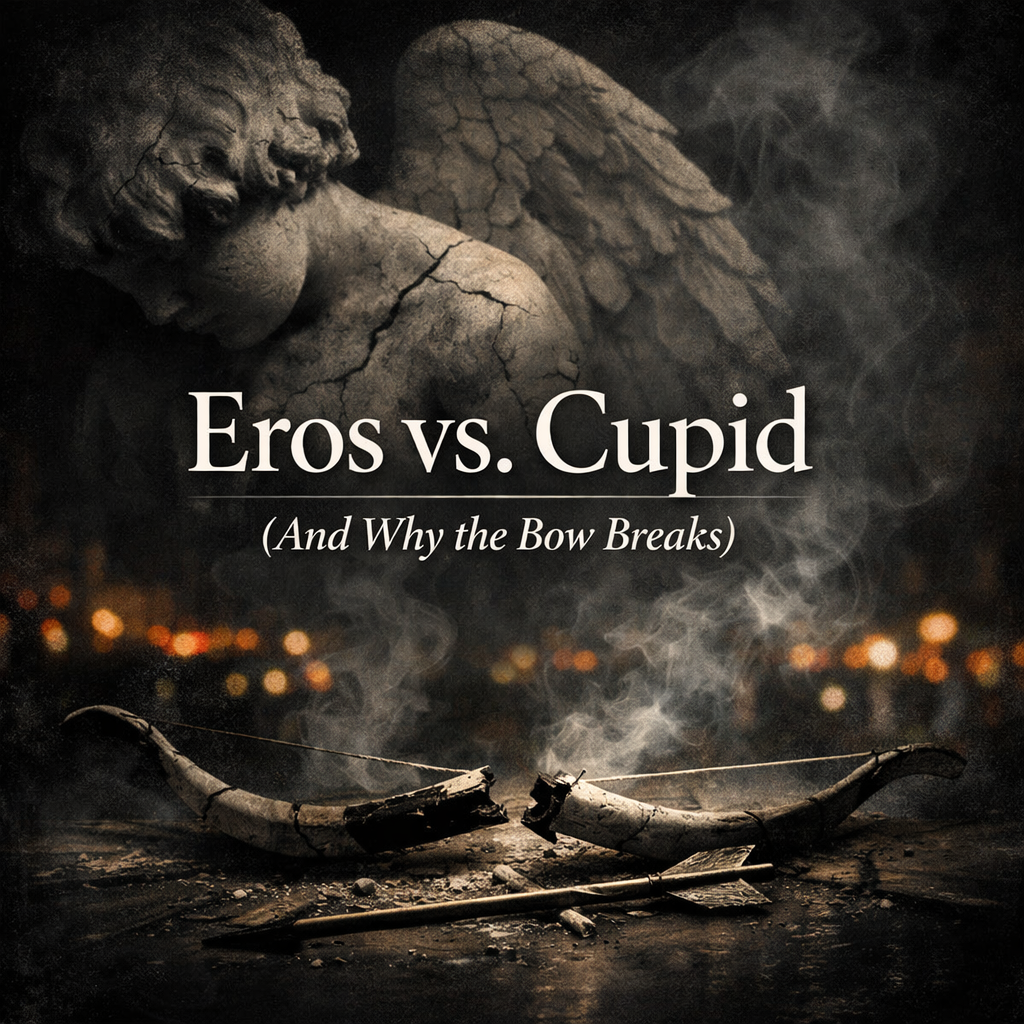
Cupid’s broken bow is not a metaphor I’m using for flourish. It’s a symptom.
We live in a moment when love is constantly demanded of us—love of country, love of city, love of “the dream,” love of the future—while the conditions that make love sustainable are quietly removed. We are asked to feel devotion toward systems that refuse responsibility, to maintain romance for places and leaders that will not tell the truth about what they are, or what they cost.
The bow breaks when love is used as a substitute for governance. The bow breaks when desire is encouraged, but stewardship is treated as optional. The bow breaks when the story is kept shiny even as the foundation cracks.
To understand why this issue keeps returning to Cupid, it helps to make one distinction—simple, not academic, just clear enough to hold in the mind.
Eros is hunger. Cupid is product.
Eros: The Hunger
Eros is the old, raw engine of wanting. Not merely erotic, not merely personal. Eros is the force that says: I must have, I must take, I must be close to what makes me feel alive. Eros is heat. Eros is urgency. Eros does not ask permission. It is not interested in sustainability. It is interested in intensity.
In modern life, Eros often shows up wearing respectable clothing, but it still behaves like hunger.
It is the hunger for a savior in politics—someone to “fix it” quickly, someone to make the mess disappear, someone who can restore a lost feeling. It is the hunger for certainty in a world that has become complicated. It is the hunger to win rather than to build. It is the hunger to belong to a side so fully that the side becomes a substitute for a conscience.
Eros is also the hunger that drives the way we consume places. The tourism version of desire is rarely described as desire, but it behaves exactly the same way. I want the city the way it looked in the film. I want the sunset without the smoke. I want the canal without the flood. I want the ancient stones without the heat, the crowd, the labor, the reality. I want the photograph, the feeling, the proof that I was there—without the humility of asking what “there” is becoming.
Eros burns hot. It makes everything feel urgent. It also burns out. That is not a moral judgment; it is the physics of appetite. Appetite does not naturally turn itself into care. It must be taught. It must be trained. It must learn limits, or it turns predatory. It must learn patience, or it becomes brittle.
And in 2026 conditions—heat, inequality, distrust, institutional fatigue—Eros is easy to trigger and hard to satisfy. That’s why it can be so dangerous. Eros is not wrong for existing. Eros is wrong when it becomes the only language we have.
Cupid: The Product
Cupid is something else. Cupid is the softened version of desire—the cherub, the harmless arrow, the brand-friendly icon. Cupid is what happens when love is turned into an image that can be sold. Cupid does not want the full truth. Cupid wants the feeling of truth.
If Eros is hunger, Cupid is packaging. Cupid is the romance industry.
Cupid is the way nations sell themselves as myths rather than as responsibilities. Cupid is the way democracies are marketed as identities—something you are—rather than practices—something you do. Cupid is the way cities are exported as symbols while the conditions inside them are edited out: the cost of living, the labor unrest, the strained public services, the surveillance, the exhaustion.
Cupid is the brochure version of reality. It is not necessarily a lie, but it is never the whole truth. It selects. It smooths. It polishes.
And because Cupid is concerned with image, Cupid is intensely sensitive to disruption. Cupid needs the lights on. Cupid needs the story intact. Cupid needs the illusion protected, even when the illusion has become a trap.
This is how large projects, public rituals, and grand promises often get framed: as romance. “We’ve solved it.” “We’re restoring it.” “We’re bringing it back.” “Trust us.” The rhetoric is not only about policy; it is about reassurance. It is about keeping the citizen, the visitor, the believer inside the feeling.
Cupid doesn’t want you to ask what the feeling costs. Cupid wants you to keep buying it.
Why the Bow Breaks
So why does the bow break now?
Because Eros and Cupid both fail under pressure, and pressure is the defining climate—literal and political—of this decade.
Eros fails because hunger cannot become a stable foundation by itself. In a stressed world, Eros intensifies. People become more desperate for relief, more desperate for certainty, more desperate for someone to blame or someone to worship. Appetite becomes a shortcut for meaning. But appetite is volatile. It can be redirected, exploited, or exhausted. A culture running on Eros is constantly at risk of whiplash—infatuation followed by betrayal, fever followed by collapse.
Cupid fails because image cannot withstand reality forever. Under climate stress and civic strain, the distance between the brochure and the lived experience becomes too large to sustain. The myth can be repeated, but it stops producing comfort. It starts producing resentment. People begin to notice the lighting rig. They begin to see the seams. They begin to ask why the performance is so expensive, and who pays.
When Eros drives the impulse and Cupid sells the story, we get a particular kind of collective heartbreak: we fall in love quickly, loudly, and publicly—with a leader, a city, a project, a national idea—and then we discover that what we loved was not built to hold the weight we placed upon it.
That is the broken bow. Not that love is impossible, but that the tools we have been given for love are inadequate to the moment we are living through.
Case Echoes: Where the Myth Meets the Weather
Venice’s sea defenses were framed, for years, as romance: a promise that a beloved city could remain exactly what the world wanted it to be. When a project like that becomes a symbol, it doesn’t just carry engineering expectations. It carries emotional expectations. It becomes a reassurance machine. And when the machine stutters—through delay, scandal, overselling, or ecological complexity—the disappointment is larger than the policy failure. It becomes intimate. “You promised. You said we were safe.”
In Greece, the shock is quieter but sharper: when heat closes ancient sites, the myth is forced to pause. The birthplace story meets temperature. History meets physiology. Suddenly, endurance looks like vulnerability. And when vulnerability appears, the romance of permanence breaks. A place we believed would outlast us is negotiating with the sun.
In Paris and America, the story is less about one weather event and more about the cumulative dimming of civic trust: the sense that institutions are operating as brands, that public life is performed rather than protected, that democracy is invoked as a romantic identity rather than practiced as a daily discipline. The lights are still on, but the atmosphere changes. Symbols are still offered, but the lived conditions underneath them feel increasingly unstable.
Across all four, the pattern repeats: romance without responsibility. Desire without care. Image without maintenance. Appetite without limits.
A Different Aim: Adult Love as Practice
If Cupid’s bow is broken, what replaces it?
Not cynicism. Not disdain. Not a global shrug.
What replaces it is adult love—love that can survive reality.
Adult love is not a feeling you fall into and then forget about. It is a practice you choose repeatedly, especially when the object of love becomes complicated. Adult love does not require denial. It requires attention.
Adult love looks like limits treated as respect, not as insult. It looks like acknowledging that places have capacities, that ecosystems have thresholds, that workers have bodies, that history has maintenance costs.
Adult love looks like refusing to confuse spectacle with health. It looks like visiting beyond the brochure, beyond the sparkle, beyond the curated myth. It looks like caring about who keeps the lights on, who is asked to sacrifice, who is told to endure.
Adult love looks like resisting the comfort of easy stories. It asks better questions. It stays when the glamour wears off—not to cling to the past, but to participate in repair.
And that, perhaps, is the most hopeful reading of a broken bow: it forces us to stop aiming at fantasies.
We do not have to stop loving cities, nations, and ideals. We have to stop loving them like children love stories—pure, unquestioned, and cost-free.
If this issue does anything, I hope it offers a new aim: devotion with eyes open. A romance that includes responsibility. A love that can stand the weather.
The Drowning Lover
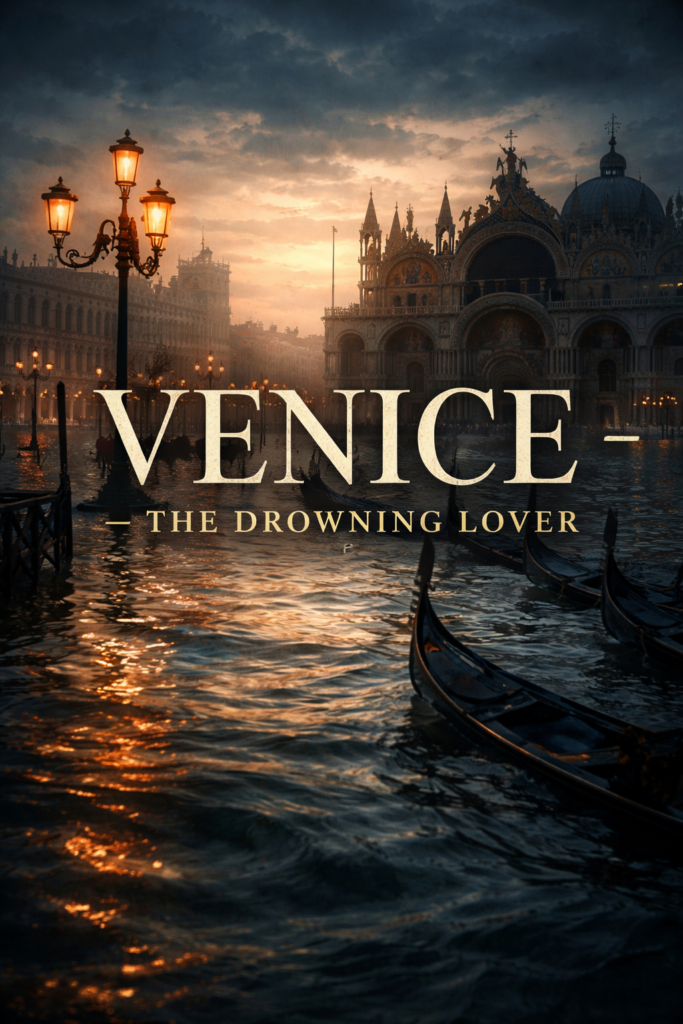
There is a sound Venice makes when you stop looking at her and start listening.
It’s not the gondolier’s song or the click of a camera shutter. It’s the quiet slap of water against stone where stone was never meant to be wet at this hour. It’s the hush of damp rising through old brick as if the city itself is breathing through a cloth. It’s the soft choreography of daily adaptation: a shopkeeper lifting a line of leather bags a few inches higher, a neighbor stepping over a threshold as though stepping over a sentence that keeps changing its ending.
Venice has always been a love story. The world’s favorite lover. A city trained to seduce—light on water, narrow alleys that turn strangers into conspirators, a skyline that feels like a stage set built for vows. But this is Cupid’s Broken Bow, and the romance is no longer clean.
The water is coming up. The timbers are tired. The myth is too heavy to carry without cracking.
Venice is an ancient agreement between human ingenuity and a lagoon that never promised to be tame. It exists because people once chose to live where living was hard, and then made hardness beautiful. For centuries, that beauty has been marketed as inevitability. Venice as permanent enchantment. Venice as timeless. Venice as if the very idea of her were enough to keep her afloat.
That’s the first lie we have to stop telling.
The city was built on wooden piles driven into mud, a kind of patient architecture that relied on the conditions of the lagoon as much as it resisted them. Underwater, wood can endure; in the absence of oxygen, it does not rot in the way people expect. For a long time, Venice survived by being exactly what she was: a floating city that understood itself as a negotiation.
But negotiations change when the other party grows angry.
Now, water is no longer an occasional inconvenience. It has become a recurring character, a persistent presence, a force with an expanding script. Acqua alta was once a story you might tell like weather folklore, an inconvenience that proved the city’s charm. Now it reads more like a warning system that no one can mute.
When disruption becomes normal, romance becomes denial.
And denial is the signature vice of our era—our preferred love language. We insist that what we adore must remain available in the form we first desired it. We treat beauty like a contract. We treat the past like a product that can be maintained through enough money, enough engineering, enough branding.
Venice has been one of the world’s greatest commodities precisely because she feels like something you can purchase without consequence. One ticket. One dinner. One gondola. One perfect photo at the blue hour. The transaction is clean; the feeling is intoxicating; the city absorbs your longing and gives you its reflection.
But the city is not a mirror. It is a body.
And the body has been paying.
There is an intimacy to Venice’s decline that makes it hard to look away. Other places burn in spectacular violence. Venice drowns quietly, patiently, almost politely. Her tragedy arrives in inches and damp lines and maintenance budgets, in the slow creep of salt through masonry and the recurrent inconvenience that becomes a permanent tax on life.
Even the romance economy has begun to show its teeth.
Tourism in Venice is not merely crowds; it is pressure. It is housing treated as inventory instead of home. It is daily life pushed to the edges of the frame so the center can remain photogenic. It is the conversion of a city into an experience. When millions “love” Venice, the city can still be abandoned—because the love is for the feeling, not the responsibility.
This is one of the cruel paradoxes of modern devotion: being desired by the world can become a kind of loneliness.
Venice has always been vulnerable, but our era has a particular talent for turning vulnerability into spectacle. We arrive in search of timelessness, and then we are surprised to find time has teeth. We arrive to consume beauty, and then we bristle at the cost of preserving it. We arrive for romance, and then we recoil when romance demands adulthood.
Which is how we get to the promise that sounded right.
MOSE.
Even the name feels like a myth: Moses, the water parted, the city saved. A grand mechanism designed to defend Venice from the sea—gates that could rise when needed, a barrier between fragile beauty and the indifferent physics of water.
This is exactly the kind of thing Cupid’s broken bow points toward: a fix that felt inevitable because we wanted it to be.
MOSE was sold as salvation. An engineering romance. A proof that human ingenuity could outflirt nature. It came wrapped in the language of protection, of destiny, of rescuing a beloved city from an unthinkable fate.
But salvation stories are dangerous when they become substitutes for truth.
Because the truth is that Venice cannot be “saved” into permanence by one grand project, not when the conditions that threaten her are systemic—climate change, ecological complexity, political incentives, and the romance industry itself. A city does not drown only because the water rises. It drowns because the people in power keep treating it as something to be exploited, managed, pitched, and monetized rather than lived in and cared for.
MOSE, for many, became less a tool and more a belief. A permission slip. If the gates exist, then perhaps we can keep doing what we’re doing. Keep selling the city. Keep delaying the uncomfortable choices. Keep pretending the lagoon is merely a backdrop for our weddings.
And then the story fractured—as these stories often do.
Corruption didn’t merely stain the project; it revealed the moral ecosystem around it. A rescue can be technically brilliant and still be spiritually dishonest if it is built inside a system that rewards shortcuts, backroom favors, and the intoxication of big promises. If the city becomes a stage, then even salvation can become performance.
That’s the broken bow. The moment when love stops being a commitment and becomes a pitch.
It is easy, from a distance, to talk about engineering and corruption as separate categories—one is technical, the other is moral. But in a place like Venice, the categories bleed into each other. The city’s future is not only a matter of physics; it is a matter of governance, incentives, and the willingness to tell the truth about limits.
Because the sea does not care about your narrative.
The sea does not care about your nostalgia.
The sea will not be swayed by the romance of “Venice must endure because Venice is Venice.”
That line is the kind of prayer people whisper when they do not want to change.
And yet change is already here. It arrives in waterlines on walls and the altered rhythm of seasons. It arrives in who can afford to live there, who is pushed out, who stays because the city is still home even when home becomes difficult. It arrives in the quiet labor of maintenance—work that rarely appears in the brochure but without which the city would become a museum of damp ruins.
Venice is often described as a miracle. And it is. But miracles require upkeep.
There is a temptation, when writing about Venice, to become melodramatic. To treat her as a doomed lover whose tragedy is inevitable. But that is another kind of romantic lie. It lets the rest of us off the hook. It lets us watch decline as though decline is the natural ending of a beautiful story rather than the consequence of choices.
So here is the turn, the place where the essay must mature.
If we are falling out of love with places, we need to be honest about why. It is not because the places have stopped being beautiful. It is because the fantasy we purchased cannot survive reality.
Adult love does not demand a city remain unchanged. Adult love does not insist a place stay available on demand. Adult love acknowledges limits, listens to systems, and understands that beauty is not a right—it is a relationship.
To love Venice honestly now is to let go of entitlement.
It is to stop treating access as proof of affection.
It is to stop calling it love if what you mean is consumption.
It is to visit differently. To move through the city with reverence instead of conquest. To notice the labor under the enchantment. To ask who pays for your dream. To look at the water not as a prop but as a force. To accept that the city is not a souvenir; it is a living argument between human desire and environmental reality.
Venice does not need fewer admirers. Venice needs fewer extractors.
And perhaps that is the deeper point of Cupid’s Broken Bow. The collapse of an illusion is not the end of love. It is the beginning of a more honest form of devotion.
The city will still glow at dusk. Light will still ripple on water and make it look like romance. But if you’ve been paying attention, you will see the second truth beneath the first: the glow is not a promise. It is a question.
What do you owe the places you claim to love?
And what does it mean to love something that cannot be kept the way you first wanted it?
Venezia, una città d’amore una volta—ora, un amore che annega.
Venice, once a city of love—now, a love that drowns.
Not because the city is unworthy of devotion. But because devotion without responsibility is only hunger, and hunger always consumes what it claims to cherish.
In the fractures—between water and stone, between myth and maintenance, between brochure and body—there is still light.
MOSE and the Price of a Promised Rescue
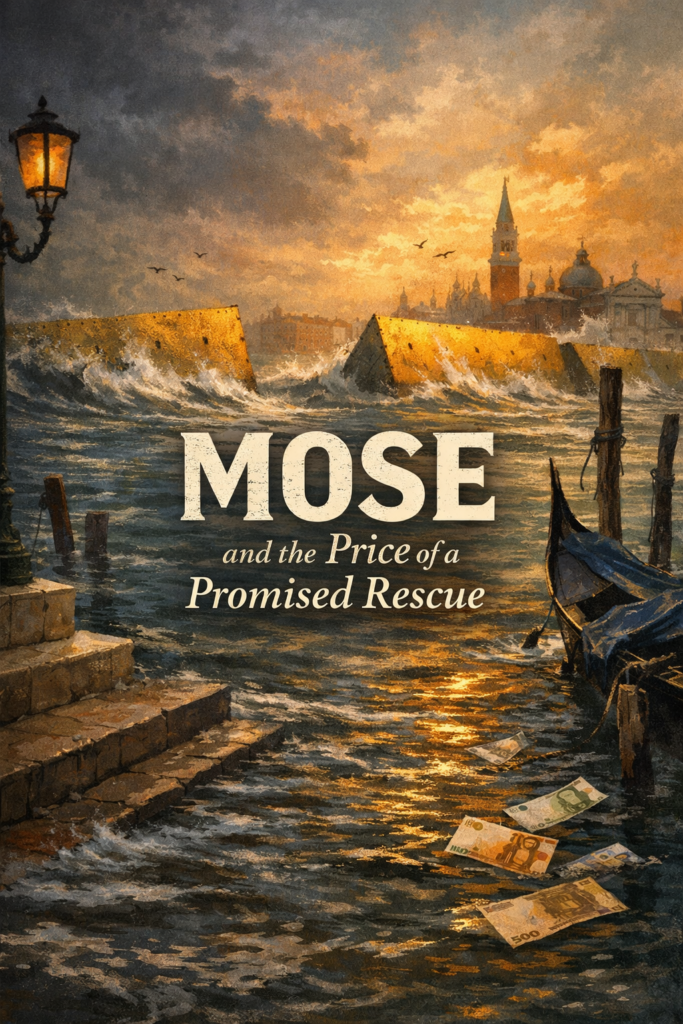
Venice has always been good at seduction. Even its disasters arrive in a costume: moonlight on water, the slow choreography of gondolas, the hush of alleyways that funnel you toward a bridge as if the city is leading you by the hand. For centuries, the romance has been part of the bargain. You come for beauty, you leave believing beauty is permanent.
But the water does not belong to the story. It belongs to the physics of a warming world, to tides and wind and pressure systems, to a lagoon that has never promised to behave. When flooding becomes familiar, romance becomes a kind of denial. That’s the moment the rescue fantasy appears: the belief that somewhere there is a single mechanism—one grand intervention—that can keep the beloved exactly as she was.
MOSE was built to be that fantasy.
In the plainest terms, MOSE is a system designed to hold back exceptional high tides and protect Venice from flooding. It is, on paper, an act of devotion: a barrier raised between a city and the sea, a refusal to surrender. It is also a declaration of control, a promise that the element Venice has always lived with can be negotiated into obedience.
That promise matters as much as the engineering. Venice is not only a city; it is an idea we export. A floating museum. A honeymoon set. A dream in stone. To admit that the dream has limits is to admit that we have limits, too. MOSE did not simply offer protection. It offered reassurance. It offered a way for the myth to continue uninterrupted.
And this is where the story becomes larger than Venice.
Because the way we sell salvation looks an awful lot like the way we sell love: confidently, beautifully, and with selective honesty.
“We can fix it,” we say. Not carefully. Not conditionally. Not with the humility that any living system demands. We say it the way a lover says, “I’ll never leave,” as if permanence is a vow we have the power to enforce. We prefer the grand gesture because it flatters us—because it feels decisive and cinematic, because it allows us to believe that the future can be solved in one dramatic scene.
Big projects become romance stories. They promise certainty. They promise a return to normal. They promise that the past—glorious, photogenic, profitable—can be preserved like a pressed flower.
But a city is not a pressed flower, and the sea is not sentimental.
When a rescue becomes symbolic, it attracts the forces that always gather around symbols: money, influence, urgency, and the temptation to perform. That is where the price begins to appear—not only in budgets and timelines, but in trust and ecology and the daily life of a place asked to live inside a promise.
There is a civic price. When the narrative is “this will save us,” every delay, compromise, and scandal—real or rumored—becomes not merely a political embarrassment but a bruise on collective belief. Citizens do not only lose patience; they lose faith. The rescue story turns into a cautionary tale, and the city learns that the people in charge can be as unreliable as the weather.
There is an ecological price, too, because the lagoon is not a wall—it is an organism. Venice survives not by separating itself from water but by living with it in a tense, intricate relationship. Any intervention that treats water as a simple enemy risks disturbing a balance that was never simple. Even the language of “barriers” and “defense” can flatten what is actually happening: the sea is not invading a foreign land; it is moving through the space it has always occupied, under conditions we have altered.
And there is a human price—the most easily overlooked. While solutions are debated, sold, corrected, and defended, people still live in the gap between promise and protection. Shopkeepers lift inventory. Residents walk the same familiar routes with different shoes. The elderly hesitate at thresholds. Workers show up anyway. The city performs romance for the world while privately learning to manage embarrassment and risk as routines.
That is the real heartbreak of the promised rescue: it asks people to endure a present that is sacrificed to the future the project claims to secure.
Even if a barrier rises, the water returns. Even if protection works sometimes, it does not become a spell that can be cast once and forgotten. The sea does not negotiate, and it does not care how much we want the postcard to remain true. There is no permanent fix for a living planet in motion. There is only adaptation, maintenance, and the sober reality that climate is not a problem you solve once. It is a condition you live within.
This is why MOSE belongs inside the theme of Cupid’s Broken Bow.
Because what breaks us is not love. It is the demand that love come with guarantees. The demand that devotion mean control. The demand that “saving” a place means preserving it exactly as we first fell for it—frozen in time, exempt from consequence, protected from the costs of our own desire.
The romance of “we can fix it” is seductive because it sounds like care. But care is not a grand gesture. Care is a practice. Care is unglamorous repetition: policies enforced, infrastructure maintained, ecosystems respected, limits accepted, people listened to. Care is an ongoing relationship with reality, not a performance designed to reassure outsiders that nothing has changed.
If we want a different kind of love for cities—one that can survive 2026 and whatever comes next—then we need to aim differently. Adult love looks like this:
Love without denial.
Beauty without entitlement.
Solutions without savior fantasies.
Repair as a practice, not a ribbon-cutting.
Protection that includes the people who live there, not just the image tourists consume.
Venice is not the only place with a MOSE story. Paris has its own versions: symbols rebuilt, prestige defended, unrest reframed as inconvenience. Greece has its own: monuments closing under heat, fire seasons returning like a grim calendar, the cradle asked to be timeless while time itself accelerates. America has its own: promises repeated until they sound like lullabies, while systems fray and the weather grows more extreme.
Different languages, same longing: that somewhere a single fix exists, and that if we build it, the story can return to its old ending.
But the ending has changed.
The good news—if we can call it that—is that the fracture is also an invitation. It forces honesty. It forces attention. It forces us to consider whether what we called love was only infatuation with an idea.
A broken bow can still teach aim. It can teach us to stop firing promises at reality and start practicing the slower devotion of stewardship. Not because it is romantic, but because it is true. And truth, even in a flooded city, is where a more durable love can begin.
THE BROKEN DREAM
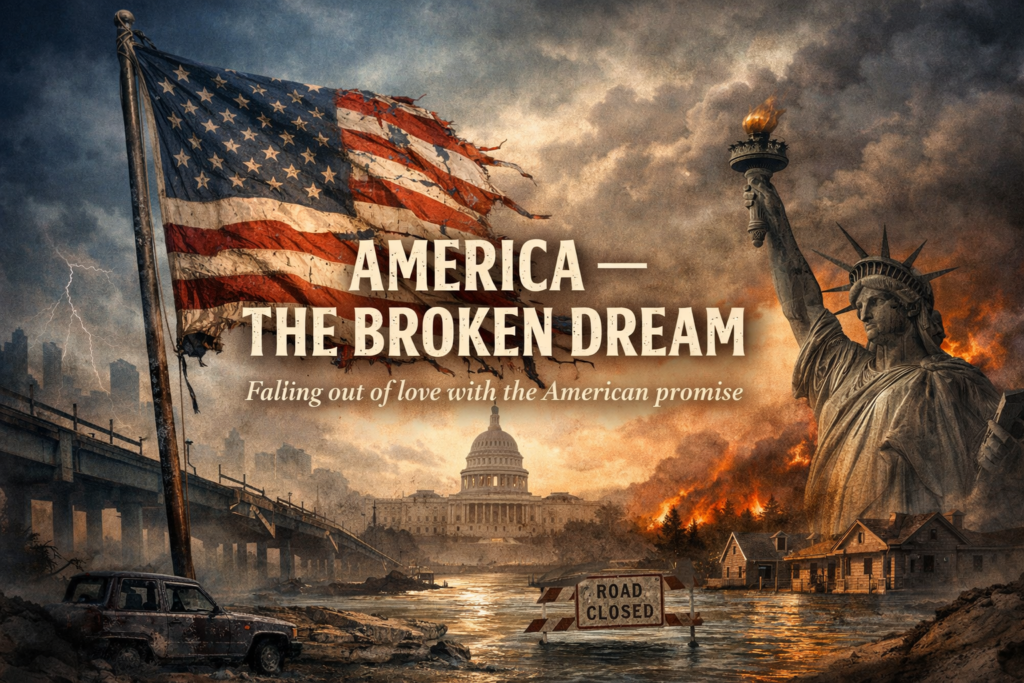
There are places you choose to love, and places you are taught to love.
America is the latter. The romance arrives early, delivered in clean phrases and ceremonial imagery: flags on school walls, a hand over a heart, a promise repeated until it feels less like a statement and more like gravity. The country is introduced as a story with a happy ending baked in. Work hard. Play fair. Believe. The arc will bend. The future will widen.
For a long time, many of us lived inside that narrative the way you live inside a love story you didn’t write. Not because it was perfect, but because it offered a kind of belonging. Even the flaws were interpreted as growing pains—proof that improvement was the nation’s natural direction.
Then, over the last twenty-five years, something changed—not all at once, not as a single moment, but as a slow accumulation of contradictions. The words remained familiar. The lived experience did not.
This essay is not a eulogy for the country. It’s a recognition that the American promise, as it has been sold, is failing the conditions it now faces. And when a promise fails, the relationship changes. Disillusionment follows. Not always as anger. Sometimes as grief. Sometimes as fatigue. Often as a quiet, shocking realization: I don’t think the story is true in the way I was told it was true.
That is what I mean by the broken dream. A romance with the idea of America that burns bright—then burns out when it is asked to carry more than it was built to carry.
The American promise has always had many versions. For some it meant opportunity: a life that could improve through effort. For some it meant liberty: the right to think, speak, worship, and live without coercion. For some it meant safety: the protection of law, of institutions, of basic predictability. For some it meant dignity: being seen as fully human in public life. For some it meant expansion: a future that held more rights, more fairness, more room.
But promises are not only ideals. Promises are practices. They require maintenance. They require honesty. They require the humility to repair what breaks.
That is where the romance frays: not because ideals are wrong, but because a country can’t live on ideals alone. When the daily machinery of public life stops delivering stability, when institutions become unreliable, when the cost of living eats the idea of “opportunity” from the inside out, when belonging becomes conditional, when the future is treated as optional—then the promise begins to sound like advertising.
And that is a uniquely modern kind of betrayal: being asked to love something that insists on describing itself in glowing terms while refusing to confront the conditions that make those terms believable.
In recent decades, American politics has drifted from stewardship toward performance. Governance has been translated into spectacle. The work of building has been replaced—too often—by the theatre of winning.
This is not simply an argument about personalities. It’s about incentives and atmosphere. When citizens are treated like audiences, politics becomes content. It must entertain, provoke, outrage, and refresh. It must keep you watching. In that ecosystem, complicated solutions are boring. Long-term planning is a bad hook. Honesty is risky. Saying “this will take time and sacrifice” is a weak pitch against someone promising a shortcut.
So the promise gets marketed instead.
Freedom becomes a slogan rather than a responsibility.
Greatness becomes a costume rather than a plan.
Heritage becomes a shield rather than a living inheritance.
The future becomes a campaign ad rather than a public project.
And the citizen is invited into a romance with a fantasy of competence: the idea that someone, somewhere, is firmly holding the wheel. The problem is that you can perform control without building capacity. You can declare strength while letting systems decay. You can celebrate the story while the infrastructure that supports the story begins to buckle.
At the same time, violence has seeped into the background of American life in a way that changes what love feels like. Not only the violence that makes headlines, but the quieter normalization of threat: the sense that public spaces carry an edge; that ordinary conflicts can escalate; that safety is increasingly privatized—bought, gated, armed, or outsourced to personal vigilance.
A nation asks for devotion when it asks people to believe they can live freely. But freedom is difficult to feel when fear becomes routine. When you brace yourself as a default posture. When the horizon of public life is shaped by what might happen if things go wrong.
In that environment, patriotism becomes strained. Civic pride begins to feel like denial. The romance breaks down because you cannot keep declaring love for a place while also mentally calculating how to survive it.
Then there is climate—an intimate, physical betrayal that no amount of rhetoric can wish away.
Climate neglect is not merely an environmental issue. It is a character test. It reveals whether a country takes responsibility for the world its children will inhabit, or whether it treats the future as a sacrifice zone.
We have reached a point where disasters are no longer rare interruptions. They are recurring seasons. The question is not whether a community will be tested, but how often—and how much help will arrive, and how quickly, and with what seriousness. Yet the national response so often remains stuck in the rhythm of news cycles: shock, sympathy, funding battles, forgetting. The pattern repeats, and the underlying conditions deepen.
A country that asks you to love it while refusing to protect the conditions that make life livable is asking for a kind of romantic loyalty that belongs to a fairy tale. It is asking you to stay devoted while it postpones the work. It is, in effect, asking you to be in a relationship with someone who keeps promising to change and keeps choosing not to.
This is where the broken dream becomes painfully clear: the American promise is not just threatened by external forces. It is weakened by internal refusal—the refusal to treat stewardship as sacred, to treat infrastructure as moral, to treat public health and environmental stability as core obligations rather than political bargaining chips.
Add to this the civic fracture that now defines daily life for many: neighbors turned into factions, institutions turned into enemy symbols, truth treated as a tribal possession.
The United States has always been plural. Diversity has always been part of the national reality, sometimes celebrated, sometimes suppressed, often contested. But the last quarter-century has altered the emotional texture of disagreement. The argument is no longer only about policy. It is about reality itself. About what counts as fact. About whether basic civic rules are legitimate. About whether one side’s existence is a threat to the other’s survival.
In that atmosphere, democracy stops feeling like a shared project and starts feeling like an endless emergency. It becomes exhausting to participate. It becomes tempting to withdraw. And withdrawal—over time—becomes another kind of loss. Not dramatic, but corrosive: a slow surrender of public life to the loudest, most extreme, most shameless voices in the room.
This is the point where many people experience the emotional shift that defines this issue’s theme: falling out of love.
Not falling into hatred. Not abandoning care. Falling out of the spell.
Because a spell is exactly what a national myth can be: an enchantment that makes contradictions tolerable. A story that smooths over gaps. A belief that the arc will bend on its own, without being pushed, without being defended, without being repaired.
When that enchantment breaks, what remains is grief and clarity. And that clarity can be brutal. It says: the promise is not automatic. The promise is not self-executing. The promise is not immune to rot. The promise is not guaranteed simply because we repeat it.
But there is another truth that follows, and it matters if we want this essay—and this issue—to end somewhere useful:
Disillusionment is not the same as abandonment.
Sometimes falling out of love is the beginning of adult love.
Adult love doesn’t demand that the beloved stay perfect. It demands that the beloved stay honest. Adult love doesn’t confuse devotion with denial. It doesn’t confuse pride with propaganda. It knows that commitment is measured by what you repair, not what you recite.
So what does adult love of a country look like—especially a country whose myths have been used to sell people on a version of reality that no longer holds?
It looks like refusing the romance of shortcuts.
It looks like resisting the seduction of saviors.
It looks like choosing stewardship over spectacle.
It looks like insisting that safety is a public good, not a private luxury.
It looks like treating truth as a civic duty, not a factional weapon.
It looks like recognizing that freedom without responsibility becomes cruelty.
It looks like holding institutions accountable without burning down the idea of institutions.
It looks like admitting that the future requires maintenance—policy, infrastructure, planning, courage—over and over again.
This is not glamorous work. It will not photograph well. It will not fit into a slogan. It will not create the clean emotional payoff of a triumphant national montage.
But it is real. And real is what the broken dream demands from us now.
Because the most dangerous thing about the American romance is not that it is inspiring. Inspiration can be a beginning. The danger is that romance can become a substitute for repair. It can become a permission slip to keep believing without acting. It can become a way to keep consuming the feeling of patriotism while avoiding the obligations patriotism should require.
When that happens, the promise becomes a product. And products are designed to be purchased, displayed, and replaced—not practiced.
The broken dream, then, is not only the loss of faith. It is the revelation that faith without work is fragile, and that a nation’s most beautiful words can be turned into decoration if they are not backed by governance that protects daily life.
If you are reading this and feeling that familiar mix—sobering clarity and a strange, renewed curiosity—then you are already inside the real subject of this issue. Curiosity is what remains when the spell breaks and you decide not to turn away. It is the impulse to look past the brochure and ask what is actually true. It is the willingness to see the mechanisms: who profits, who pays, who suffers, who is silenced, who is kept safe, who is asked to endure. It is the beginning of an honest relationship with place.
America is still a place worth caring about. But it is not a place that can be loved responsibly as a myth.
The dream is broken. That does not mean the country is doomed. It means we are out of the honeymoon stage. It means the only love that makes sense now is the kind that tells the truth and does the work.
And perhaps that is the quiet optimism at the end of this: when romantic love burns out, a different kind of devotion becomes possible. Not the devotion of fantasy, but the devotion of practice.
In the fractures, there is still light. Not because the story is automatically happy, but because the break reveals what must be rebuilt—and reminds us that rebuilding is not a moment. It is a way of living.
Through The Rainbow Lens
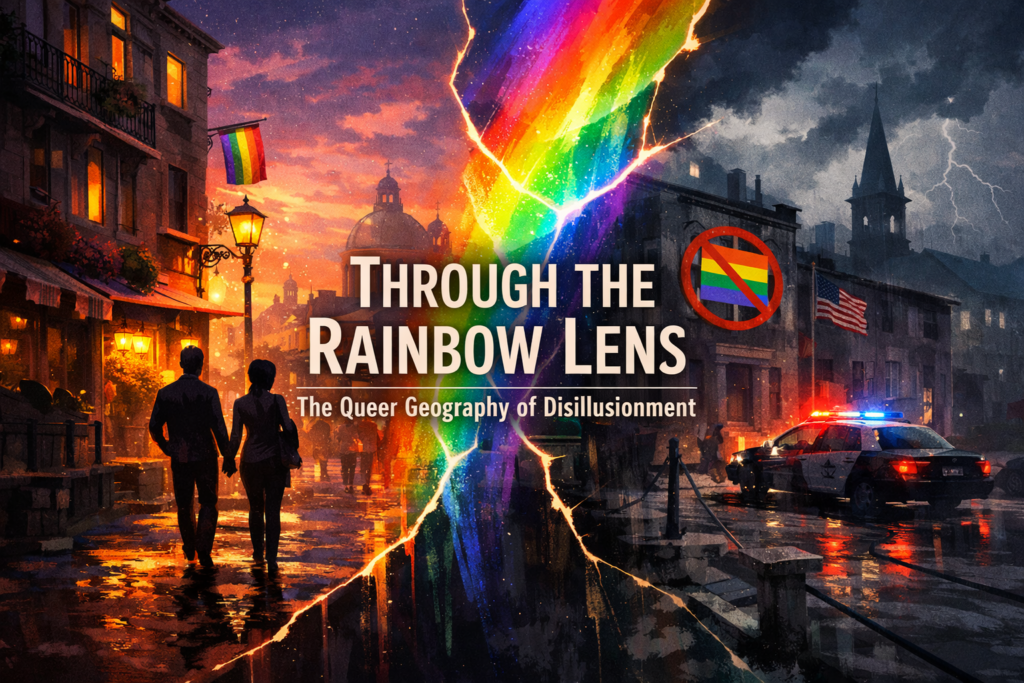
There are departures that don’t require a suitcase.
They begin with a glance over the shoulder before a hand is held. With an instinctive recalibration of voice, posture, affection. With the quiet decision to take a different street, leave the bar early, keep the “we” out of a story at work. You don’t announce it. You don’t even always admit it to yourself. But something inside you has moved.
Queer people learn geography in a way that is rarely taught on maps. Not simply where the museums are, or where the cafés glow prettiest at dusk, but where the air changes. Where the room gets colder. Where belonging is offered generously and where it is extended only with conditions.
This month, Cupid’s Broken Bow is about falling out of love with myths — with cities, nations, leaders, and the reassuring stories they tell about themselves. Through a queer lens, “falling out of love with a place” is not an aesthetic disappointment. It can be a survival skill. It can be the moment you realize the city you adored loves you back only when you are discreet, quiet, assimilated, grateful, or invisible.
Conditional belonging is the real heartbreak. Not that a place has flaws, but that the place requires you to perform your right to exist.
There is a romance myth that haunts modern life: that progress is permanent. That safe places remain safe. That history moves forward in a straight line, brightening as it goes. Many of us were raised on a version of this story. We watched rights become law. We watched representation expand. We watched language change. We watched entire industries pivot to display inclusion like a badge.
And still, the lights flicker.
Anyone who has lived under conditional acceptance knows how quickly the room can change. A new law. A new administration. A new moral panic. A new headline that turns human beings into “issues.” A new wave of harassment that makes everyday errands feel like exposure. The shift doesn’t always arrive as a dramatic break. Sometimes it is simply a tightening: a sense of being watched again, discussed again, revised again.
That is what queer geography measures. Not distance, but temperature. Not landmarks, but permissions.
Leaving without moving
When people talk about leaving a place, they usually mean relocation: the move across state lines, the job change, the packed boxes, the clean break. But queer people often leave long before they go anywhere.
They leave a little at a time.
They stop holding hands in the same neighborhood they once strolled through as if it belonged to them. They stop kissing goodbye at the train platform. They stop correcting the coworker who “doesn’t mean anything by it.” They stop bringing their whole life into conversation. Their radius shrinks. Their instincts sharpen.
This is an emotional exit — the moment a person begins to detach from a place that has become unpredictable. It can look like caution. It can look like “being practical.” But underneath it is grief: the loss of ease.
Ease is one of the great gifts of belonging. It is also one of the first things conditional acceptance takes away.
When your love becomes labor
Some places require more calculations than others. Not because queer people are fragile, but because certain environments are built on a constant assessment of who has the right to be comfortable.
In those places, love becomes labor.
You learn to read the signals. The flags and the flyers. The way people stare. The jokes that get told. The news stories that always seem to orbit your identity as if you are a controversy rather than a neighbor. You learn which restaurants are safe and which ones feel like they are waiting for you to slip up. You learn which parts of town are tolerant in daylight and which ones become hostile after dark. You learn how to dress for invisibility when you’re tired, and how to present confidence when you have the energy to risk it.
None of this is dramatic in the moment. That’s part of the cruelty. It is daily. It is cumulative. It wears down joy the way water wears down stone.
A simple truth emerges in places like this: if your belonging requires constant strategy, the place is not loving you back.
The map has layers
Queer geography isn’t only about culture. It’s a layered map made of law, social temperature, and economics — and those layers don’t always align.
Law is the most obvious layer. Rights can expand or contract; protections can appear or vanish; enforcement can be uneven; court decisions can land like weather events. But even when laws look good on paper, everyday life can still be hostile. And even when laws are hostile, pockets of safety can exist within them — community-made sanctuaries that function like shelters during a storm.
That’s the second layer: culture. The temperature of a place. A city can be legally progressive and socially cruel, or legally restrictive and socially supportive in certain circles. Sometimes the difference is neighborhood to neighborhood, school to school, workplace to workplace. Culture is what tells you whether your rights will be respected when no one is watching.
The third layer is economics, and it is often the most decisive. Who can afford to leave? Who can afford to commute to safety? Who can pay higher rent for a neighborhood where they won’t be harassed? Who can switch jobs, lose family support, start over? “Just move” is advice that assumes mobility as a privilege. For many queer people, leaving is not a choice. It is a fantasy.
This is why disillusionment can feel like being trapped in a relationship that keeps changing its rules. The place you love is not always a place you can stay.
The myth we are falling out of love with
The myth is not that places can be beautiful. They can. The myth is that beauty equals safety, or that reputation equals belonging, or that progress is a permanent state.
Many of us were taught to love certain cities the way we are taught to love famous romances: they are supposed to be safe because they are celebrated. They are supposed to be enlightened because they are expensive. They are supposed to be welcoming because their marketing says so.
But marketing is Cupid’s specialty. Cupid sells the feeling of love and asks you not to inspect the conditions.
Under this month’s theme, “falling out of love” doesn’t mean turning cynical. It means breaking the spell. It means admitting that a city can host a parade and still treat queer people as a controversy the rest of the year. It means noticing how quickly inclusion becomes a seasonal costume.
It also means recognizing that democracy itself can become a romance myth — the belief that the system will protect you because you are a citizen, because you are good, because you belong. When that belief cracks, the pain is not only political. It is personal. It is the grief of discovering that your safety depends on who is in power, what they need, and which people they’ve chosen as symbols.
The choice set: how queer people respond to disillusionment
When you fall out of love with a place, you still have to decide how to live inside it. Queer people tend to develop strategies that are less about ideology and more about reality.
Some stay and build. They create institutions and networks that make a place livable: community centers, support groups, mutual aid circles, chosen-family structures, advocacy organizations. They become the reason a place is safer than it would otherwise be. Their love is a kind of stewardship.
Some leave and survive. They relocate not because they are weak, but because they are wise. They choose safety, healthcare, stable employment, a future that does not require constant calculation. Leaving can be an act of self-respect. It can also be grief in motion.
Some split their lives. They live one version of themselves in one place and another version elsewhere. They keep a foot in a safer city while maintaining ties to family or work in a less safe one. They travel for ease. They create “seasonal safety.” They code-switch across geography because they have learned what the map demands.
Some refuse the script entirely. They build micro-sanctuaries wherever they are — a house, a friend group, a bar that becomes a refuge, a garden, a circle of people who can breathe freely together. These aren’t perfect solutions, but they are the ways queer people keep life luminous when the larger world flickers.
None of these strategies are morally pure. They are human responses to conditional belonging. The question is not which is most virtuous, but which is most sustainable.
How to visit differently, queerly
This issue invites readers to look past brochures and sparkle. Through the rainbow lens, that invitation sharpens.
When you visit a place, ask different questions.
Who is safe here after dark?
Who can be openly in love?
Who is policed — by law, by custom, by stares — for simply existing?
What neighborhoods are celebrated, and what neighborhoods are ignored?
Where are queer people welcomed as people, and where are they tolerated as entertainment?
These questions do not ruin beauty. They deepen it. They turn a city from a stage set into a living moral environment. They also reveal whether your idea of a place is built on someone else’s silence.
Disillusionment as a kind of clarity
Falling out of love with a myth can hurt, but it can also return you to reality-based devotion.
There is a version of love that depends on illusions: the belief that a place is safe because it is famous, the belief that rights are secure because they were once expanded, the belief that democracy automatically protects those it claims. When that kind of love collapses, it can leave bitterness behind.
But there is another kind of love — adult love — that begins where the postcard ends. It doesn’t require denial. It doesn’t ask you to pretend the room is warm when it isn’t. It doesn’t insist that you keep offering your body and your joy to a place that treats you as conditional.
Adult love for a place is a practice. It is built from attention, truth-telling, and repair. It can include celebration, but it is not dependent on performance. It can contain pride, but not propaganda. It can be hopeful, but not naïve.
For queer people, this kind of love often looks like community: the people who make you feel real. The spaces where you can breathe. The networks that catch you when the larger system fails. If a city or a nation won’t guarantee belonging, queer people learn to manufacture it out of care.
That is not a consolation prize. It is a blueprint.
A map drawn in light
If the lights are flickering, the answer is not always to flee. Sometimes it is. Sometimes it isn’t possible. Sometimes it is a slow exit. Sometimes it is a stubborn act of building.
But whether you stay or go, queer geography teaches a truth that belongs in this month’s issue: love is not a slogan. Love is not a brand. Love is not a guarantee.
Love is a relationship with reality.
When we fall out of love with a myth, we are not necessarily losing love. We may be learning what love can actually hold. We may be learning how to aim without illusions. We may be learning how to keep our own lights on when the city refuses to.
And in that sense, disillusionment can be a beginning. The fracture, once admitted, becomes a place where something honest can enter — something that isn’t glossy, isn’t conditional, isn’t dependent on permission.
The Romance of Denial

Every era has its political language. Ours speaks in courtship.
It promises “return.” It perfumes the air with “heritage.” It holds up “greatness” like a mirror and asks the public to fall in love with its reflection. It assures us that we are chosen, that the nation is strong, that decline is a lie told by enemies, that doubt itself is disloyal.
And because the world is loud with heat, strain, and uncertainty, the pitch often works.
This is the romance of denial: a form of governance that offers feelings instead of plans, symbols instead of maintenance, and a story so flattering that reality starts to feel like an insult. It is not only propaganda. It is a bargain. Believe in the love story, and you will not have to sit with fear. Accept the myth, and you can avoid the grief of limits.
The trouble is, reality doesn’t care what we promised ourselves.
A romance is not inherently false. But when romance replaces preparation, it becomes a trap. You can govern by myth for a while. You cannot govern against the weather, against the bills, against the crumbling systems that keep daily life upright. Eventually, the city floods. The monument closes. The smoke returns. The price rises. The trust fails. The bow breaks.
THE COURTSHIP LANGUAGE
Listen to how modern politics seduces.
It speaks in absolutes: always, never, forever. It speaks in destiny: this is who we are, this is what we deserve. It speaks in innocence: we were perfect until they ruined us. It speaks in purity: real people, true faith, authentic culture. It speaks in return: go back, restore, reclaim, make it like it was.
Courtship language is designed to bypass the part of us that asks practical questions. It aims for the nervous system. It wants a yes that arrives before thought. It wants consent that feels like love.
And because many people have been battered by economic whiplash, social volatility, and the ongoing sense that the future is a tightening corridor, the desire for certainty is understandable. Romance offers certainty. Romance offers a single beloved object and a simple plot: devotion, betrayal, victory, reunion. No spreadsheets. No tradeoffs. No guilt.
But civic life is made of tradeoffs. Real leadership is made of details. A nation cannot be run on longing alone.
THE TOOLKIT OF DENIAL
The romance of denial has a predictable toolkit. It changes costumes, but the structure remains.
Heritage as perfume. The past is invoked not as a teacher but as a fragrance meant to cover rot. The story becomes: We were once pure and whole, so we can be again, without sacrifice, without adaptation, without change.
Greatness as a mirror. Citizens are flattered into consent. If you question the project, you are told you must hate the country. If you demand evidence, you are told you are humiliating the nation. Pride is weaponized against scrutiny.
Return as a lullaby. “Return” is one of the most soothing words in political speech because it implies that the hardest part has already been done. We don’t have to build; we only have to go back. The future becomes a past that never existed in the way it is described.
Enemies as plot. Every romance needs a villain. The villain might be outsiders, elites, bureaucrats, immigrants, activists, journalists, academics, rival parties, rival nations—anyone who can be used to explain pain without admitting complexity. Scapegoats are cheaper than policy.
Spectacle as proof. Pageantry becomes a substitute for outcomes. A ribbon cutting stands in for readiness. A speech stands in for a plan. A slogan stands in for a budget. A symbol stands in for repair.
The deeper move is this: the romance of denial turns citizens into an audience. We are asked to watch, cheer, and identify. Not to measure, maintain, and participate.
WHAT GETS AVOIDED WHEN ROMANCE TAKES OVER
When leaders sell love stories instead of plans, certain kinds of work become unfashionable. Not because they aren’t necessary, but because they aren’t cinematic.
Maintenance. The unglamorous labor that keeps systems from failing: roads, bridges, hospitals, schools, housing, water, power. Maintenance is where governments tell the truth about priorities. Maintenance is also where myth goes to die, because broken pipes do not respond to rhetoric.
Adaptation. Preparing for the future you’re actually getting, not the future you wish you were getting. Climate readiness, emergency capacity, heat policy, flood policy, public health infrastructure. Adaptation is a confession that conditions have changed. Confession is bad for romance.
Accountability. Timelines. Costs. Performance metrics. Independent oversight. Transparency. Accountability is the opposite of seduction. It asks for proof. It insists that results matter more than applause.
Tradeoffs. No real plan exists without saying who pays and who benefits. Romance prefers to say everyone wins, no one sacrifices, and the beloved leader will handle the unpleasant parts offstage.
Inclusion. Romance politics often draws its power from narrowing the definition of who counts. The love story becomes exclusive. Belonging becomes conditional. Dissent becomes betrayal. Complexity becomes sabotage.
This is why denial is so attractive to those who wield it: a love story can be managed. A reality can’t.
THE “PROMISED RESCUE” PATTERN
One of the most intoxicating forms of denial is the promised rescue.
It goes like this: a large, dramatic solution is proposed, marketed as salvation. It promises permanence. It promises to keep the old world intact. It promises that the beloved place can remain unchanged, and that the public can keep loving it in the same easy way.
The rescue is announced with confidence, wrapped in symbolism, and defended as proof of national competence. Then reality arrives: delays, costs, complexities, unintended consequences, and the human ecosystem that gathers around money and power.
This is where romance often curdles. When a rescue becomes a symbol, it attracts those who want to profit from the symbol. Contracts, kickbacks, shortcuts, performance. The project becomes less about protection and more about proving that protection was promised.
The result is not always total failure. Sometimes the rescue works partially. Sometimes it works intermittently. Sometimes it works technically, but fails morally. In all cases, the myth it was asked to support—permanence, certainty, effortless preservation—cannot survive.
The sea does not negotiate with branding. Heat does not honor slogans. Floodwater does not pause for speeches. The world you are in will eventually collect its receipts.
ECHOES ACROSS PLACES
This pattern is not confined to one country or one ideology. It is an age-wide temptation: when conditions worsen, the appetite for romance grows.
In cities made famous by illumination, prestige can become a substitute for preparedness. The belief that cultural importance equals immunity is a kind of denial: surely a place this symbolic will be protected by its symbolism. Yet institutions strain. Public life frays. The gap between postcard and lived experience widens, and the lights that once felt like a promise start to feel like a performance.
In places burdened by origin stories—cradles of democracy, birthplaces of civilization—myth can become a weight. A country can be loved as a concept while struggling as a system. Austerity can hollow out readiness. Heat can rewrite the rules. When even the most sacred monuments must close under extreme conditions, the message is brutal in its simplicity: identity cannot outvote temperature.
In nations built on promises, the romance can be the most aggressive of all. Destiny is invoked as entitlement. Greatness is sold as inheritance rather than work. Citizens are asked to fall in love with a story and to treat evidence as an affront. Meanwhile, violence hardens daily life, trust collapses, and the future is treated like an optional upgrade rather than a duty.
Different places, similar seductions: keep believing, keep applauding, keep longing. Don’t look too closely. Don’t ask for the maintenance budget. Don’t ask who is being sacrificed so the story can remain flattering.
WHEN CITIZENS BECOME FANS
Perhaps the most corrosive effect of romance politics is that it changes the public role. We are trained to behave like fans: loyal, reactive, protective of the brand. We defend the story because we have invested our identity in it.
In that atmosphere, truth becomes infidelity. If you point out structural decay, you are accused of disloyalty. If you ask for planning, you are accused of pessimism. If you demand accountability, you are told you are ruining morale. If you insist on limits, you are labeled an enemy of hope.
But there is a difference between hope and fantasy. Hope is a discipline. Fantasy is a product.
When governance becomes romance, leaders are rewarded for making people feel good rather than making systems work. And because feelings are immediate and systems are slow, romance wins in the short term. Then the short term ends.
ADULT LOVE: WHAT RESPONSIBLE LEADERSHIP LOOKS LIKE
If the romance of denial is seductive, what replaces it?
Not cynicism. Not despair. Not the posture of sneering at anyone who still believes. The alternative is something less glamorous and far more durable: adult love in public life.
Adult love is not a slogan. It is a practice.
It speaks plainly about tradeoffs. It admits limits without shame. It treats maintenance as patriotism. It budgets for what is boring and necessary. It prepares for the conditions we actually face. It measures outcomes. It builds institutions people can trust. It refuses scapegoats as entertainment.
Adult love also honors beauty without turning it into an alibi. It can love a city without denying its strain. It can love a country without worshipping its myths. It can cherish heritage without embalming it. It can celebrate identity without demanding that reality stay still.
This kind of love does not burn out because it does not depend on illusion.
HOW NOT TO BUY THE LOVE STORY
Readers don’t need a new ideology to resist denial. They need a new set of questions.
When you hear a leader offer romance, ask: What changes on the ground?
Ask for timelines. Ask for costs. Ask for maintenance. Ask what happens if the plan fails. Ask who pays. Ask who benefits. Ask what data will be used to measure success. Ask what institutions will provide independent oversight.
Be cautious of “return” when it replaces “prepare.” Be cautious of “heritage” when it replaces “repair.” Be cautious of “greatness” when it replaces “responsibility.”
A citizen is not a lover whose role is to adore. A citizen is a steward.
CLOSING: LOVE WITHOUT ILLUSION
Cupid’s bow breaks when love is asked to do the work that planning refuses to do.
We are living in conditions that punish fantasy. That does not mean love is obsolete. It means love must mature. It must move from infatuation to responsibility, from postcard devotion to lived commitment, from slogans to scaffolding.
The romance of denial will always be tempting, especially when the world feels unstable. It offers a quick belonging, an easy plot, a flattering mirror. But it cannot keep a city dry. It cannot keep a monument open in extreme heat. It cannot keep a society intact when maintenance is neglected and accountability is mocked.
Plans are not as thrilling as love stories. But plans are how we keep the future habitable. Plans are how we keep light from going out.
And if there’s an optimism worth keeping, it’s this: when the love story fails, we are not left with nothing. We are left with the chance to build something truer.
Falling Out of Love With Places (And What Comes After)
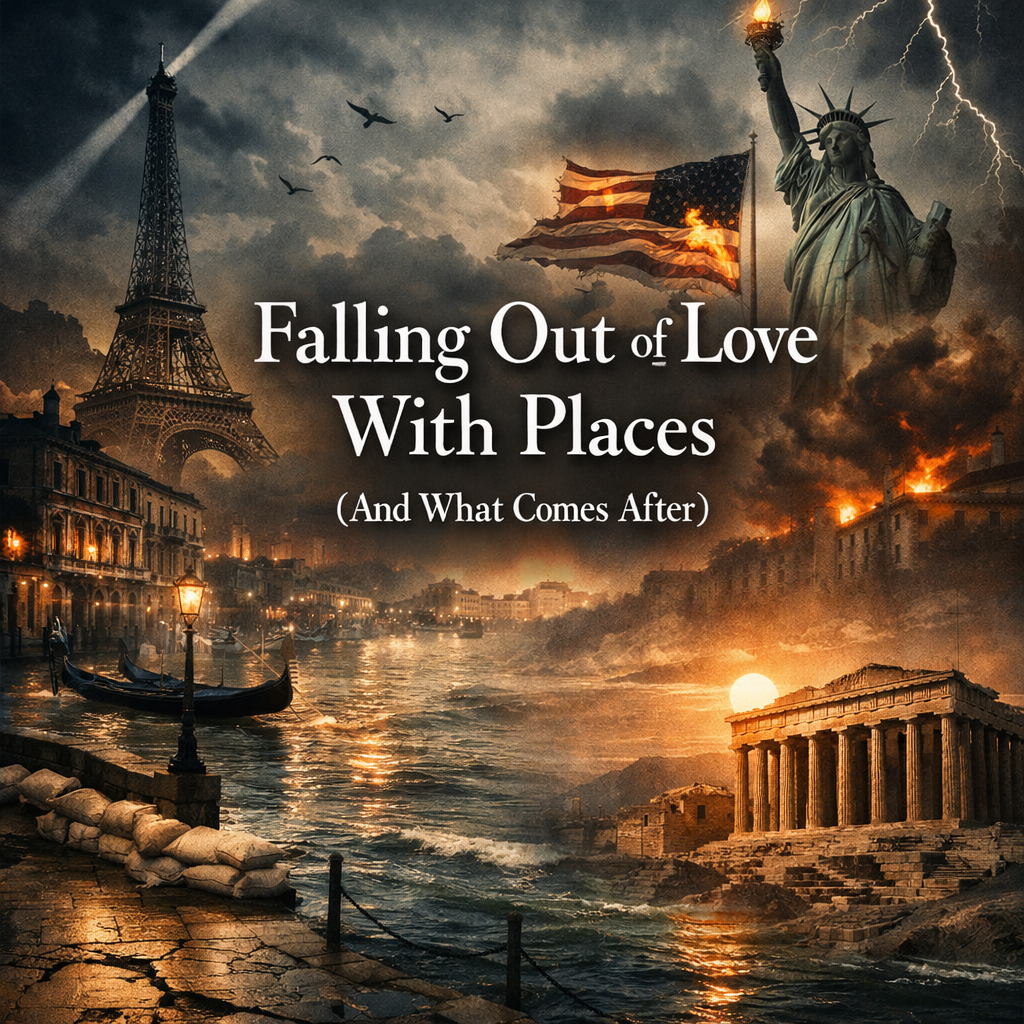
The postcard always fails first.
It fails at the edges, where the frame cuts off the inconvenient parts. It fails in the gap between the light you were promised and the life that has to be lived beneath it. It fails when water reaches a doorstep, when heat closes a landmark, when scaffolding becomes permanent, when a city’s most beautiful streets begin to feel like a stage kept upright by people who can no longer afford to live behind the curtain.
We don’t fall out of love with places all at once. We fall out of love with the story we were sold.
For most of us, “loving” a place is not a neutral act. It is attachment braided with projection. It is the belief that a city will keep its promise to us: that it will remain what it meant the first time we imagined it, that it will keep offering the feeling it once delivered. We love places for what they symbolize and what they allow us to become inside them. We love them because we’ve been trained to. We love them because the culture has already written the romance and handed us our lines.
That romance tends to sound the same across borders: timeless beauty, historical grandeur, a certain kind of light. And it comes with an unspoken bargain: if you agree to the fantasy, you will not have to see the costs.
This issue has asked what happens when that bargain breaks.
It’s tempting to call the feeling “betrayal,” as if a city or nation has turned its back on us, as if the beloved became cruel. But more often, the betrayal is not the place itself. The betrayal is the arrangement we accepted so we could keep enjoying the feeling without paying attention to what made the feeling possible.
We romanticize permanence in a world that runs on maintenance.
We romanticize stability in systems that are stressed by inequality, politics, and time.
We romanticize the surface while the body underneath struggles to hold.
If there is a pattern in how disillusionment arrives, it’s usually this:
First comes infatuation. The myth. The brochure. The national story. The city as symbol, the country as promise, the landmark as proof that history can be held in your hands.
Then comes friction. Small details that don’t fit the fantasy: labor unrest, a strained transit system, housing that pushes workers farther and farther out, a politics that feels less like stewardship and more like performance. We notice, but we excuse. We tell ourselves every place has problems. We keep the love intact by keeping the contradictions at the edges.
Then comes rupture. Something visible. Something you can’t crop out. Fire. Flood. Heat. Scandal. Violence. A closure sign on a monument that was supposed to be eternal. A barrier that was supposed to protect. A symbol that was supposed to reassure.
And then comes aftermath: the stage where people choose what kind of love they are capable of.
Some choose denial. They double down on the myth, insisting the romance must be preserved at any cost. The fantasy becomes a refuge, and anyone who complicates it is treated as a threat.
Some choose contempt. They decide the place is “ruined,” and they withdraw. This is the quickest way to stop feeling grief, but it’s also a way of making the world smaller and meaner.
And some choose a third path, the one this issue has quietly argued for: devotion with eyes open. The kind of love that does not demand perfection, does not require denial, and does not treat beauty as an entitlement.
Paris has long been the most famous romance on earth: the City of Light, the capital of art and elegance, the export of a certain European dream. But romance becomes brittle when it depends on performance. When a city is forced to be itself as spectacle, its symbols begin to carry too much weight. Prestigious culture is not immune to anxiety and opportunism. Civic strain becomes visible in labor disputes, in social fatigue, in the feeling that the lights are bright but the mood is dim. Even the most luminous city can flicker when trust becomes scarce.
Greece carries a different kind of projection: cradle, origin, democracy as inheritance, a mythology so widespread it feels like a universal birthright. Yet there is something clarifying—almost brutal—in the image of the Acropolis closing under extreme heat. It is history stepping out of the sun. It is the present forcing limits onto the past. It reminds us that reverence alone will not protect anything. A civilization can be admired and still be overburdened. A nation can be loved for what it gave the world and still be asked to survive what the world is now doing to it.
Venice is the world’s most desired lover, the honeymoon city, the floating miracle that people expect to remain timeless even as the sea rises. But desire can be a form of extraction. Overtourism behaves like tide: it brings money and pressure, attention and erosion. Venice is a place where the romance of salvation has been sold as infrastructure, where the promise of rescue sounded right because everyone wanted it to. And when that promise frays—when projects stumble, when corruption stains the narrative, when the lagoon’s complexity refuses simple fixes—the city becomes a parable for an entire era: we keep believing in grand gestures because we cannot bear the patience that real stewardship requires.
America is a myth of a different kind: a promise marketed as destiny. Opportunity, dignity, fairness, a future that expands. Many of us were taught to love the idea of the country as much as the country itself. But love becomes unstable when violence becomes ambient, when governance becomes theatre, when the climate is treated as a political inconvenience rather than a physical reality, when the social contract feels less like a shared vow and more like a contest. Falling out of love with the American promise doesn’t always mean hating the country. It can mean grieving the gap between what was said and what was done, between what was pledged and what was protected.
Across these places, the same question repeats: what do we owe the places we claim to love?
If we only love them as fantasies, then we owe them nothing. We owe them applause, money, attention, nostalgia. We owe them our photographs and our slogans. We owe them our insistence that they stay beautiful, stay symbolic, stay easy.
But if we love them as living places—places made of ecosystems, workers, laws, budgets, weather, and time—then the list of debts changes. Adult love brings obligations. It brings discomfort. It brings the humility of admitting limits.
Adult love does not confuse access with entitlement.
Adult love does not treat a city as a trophy.
Adult love does not demand that a place remain frozen in the version we fell for.
Adult love looks less like consumption and more like attention.
This is where the theme of Cupid’s Broken Bow becomes more than a metaphor. The bow breaks when love is asked to do the work that planning refuses to do. The bow breaks when a leader offers a feeling instead of a policy. The bow breaks when a city sells its soul as atmosphere while the foundations rot. The bow breaks when we accept the romance of “we can fix it” without asking who profits, who pays, and what happens when the fix is not permanent.
And then the question becomes: what comes after the break?
What comes after is not cynicism. Cynicism is simply another way of protecting yourself from grief.
What comes after is not nostalgia. Nostalgia is a narcotic that makes the present feel unbearable and the future feel impossible.
What comes after is a more durable kind of hope—hope as workmanship.
Hope is maintenance. It is budgeting for the unglamorous. It is investing in the systems that make life livable rather than the spectacles that make it look livable. It is climate adaptation treated as dignity, not defeat. It is housing policy treated as social stability, not a market game. It is labor respected as the foundation of culture. It is governance that can say, plainly, what the tradeoffs are and still ask people to choose responsibility.
And for the individual reader—especially the traveler, the admirer, the citizen of somewhere—the “after” can be practiced in how you move through the world.
Visit differently.
Go past the brochure, not to become superior or jaded, but to become honest. Ask what pressures are hidden beneath the shine. Notice who keeps the lights on. Notice who can no longer afford to live in the city they serve. Notice when a place is being treated as a brand rather than a home. Treat beauty as something you are allowed to witness, not something you are entitled to consume.
This doesn’t mean you must stop loving places. It means you must stop loving them as lies.
There is still light in Paris, but it is no longer a guarantee.
There is still grandeur in Greece, but it now exists under limits that must be respected.
There is still beauty in Venice, but it comes with water at the threshold and an economy that must be reimagined.
There is still possibility in America, but it will not be delivered by slogans.
If this issue has a gentle argument, it’s that falling out of love can be a form of clarity. The end of illusion is not the end of affection. It can be the beginning of a deeper, more adult devotion—one that doesn’t ask the beloved to remain perfect, and doesn’t ask the lover to remain blind.
The postcard fails first, yes. But that failure is not only a loss. It is an opening. It is where reality enters. It is where repair becomes imaginable. It is where responsibility starts to look like a kind of romance, quieter but more true.
Reflections in Verse: Cupid’s Broken Bow
Cupid,
keep your cherub grin.
This month,
your bow is a splintered thing
hung above a doorway
like a warning
we once would have called decoration.
It isn’t love that failed—
only the way we aimed it.
Only the way we asked a feeling
to do the work of weather,
to do the work of law,
to do the work of keeping faith
when faith requires hands.
The lights still come on.
They always do.
Paris knows how to perform
even when the backstage creaks,
even when the streets rehearse their hunger
with banners and closed doors,
even when the shine is more instruction
than invitation.
A river can glitter
and still carry ash.
We learned the City of Light
before we learned the city.
We loved it as an idea—
a lamp held high
so the rest of us could pretend
our own rooms were bright.
The bow breaks.
And Greece—
cradle spoken like a lullaby,
like origin means immunity.
But the marble heats
until history must step back.
Gates close,
not for ceremony
but for survival.
The sun is not a metaphor
when it presses its palm
to the forehead of a nation
and says: enough.
We do not argue with heat.
We measure it,
we name it,
we obey it.
The bow breaks.
Venice keeps her face turned toward you—
the practiced tilt,
the half-smile of a city
trained to be adored.
But water is a rude lover,
returning without apology,
tapping at thresholds,
finding the lowest truth
and lifting it.
Salt writes its own signatures
on stone.
Timbers remember
what it means to hold
a world above them.
A promise rose once—
an engineered hand
to stop the tide—
and even that promise
learned the human cost
of pretending the sea
will accept our terms.
You can call it protection.
You can call it corruption.
You can call it both.
The water will not care
what we name it.
The bow breaks.
And America—
a story told in anthems,
in slogans polished
until they shine like coins.
We were taught to love the promise
as if it were a landscape:
endless,
self-renewing,
unquestionable.
But the air changes.
The noise changes.
The future is treated like a rumor
that can be voted down.
Violence becomes background music
to shopping, to worship, to school,
and the body learns
a new kind of listening—
for exits,
for threats,
for weather.
Love becomes conditional
the way rights become conditional,
the way truth becomes conditional,
the way belonging
gets issued and revoked
like a license.
We fall out of love
not because we stop caring
but because the myth
won’t stop demanding
our blindness.
The bow breaks
when love is sold as certainty.
The bow breaks
when devotion is asked
to replace planning.
The bow breaks
when beauty becomes an industry
and the people inside it
become props.
So what is left
when the bow breaks?
Hands.
Hands that keep the lights on
without pretending light is salvation.
Hands that sweep the ash
and still remember
the fire was real.
Hands that lift
what can be lifted,
and mourn
what cannot.
Adult love—
not the fever,
not the purchase,
not the postcard kiss.
Adult love is attention.
It is limits honored
as a form of reverence.
It is maintenance
done without applause.
It is the courage
to see the city whole—
its labor,
its fractures,
its exhausted saints
and stubborn sinners—
and to love it anyway
without lying.
The bow breaks,
and we aim differently.
We aim at repair.
At accountability.
At the quiet dignity
of a plan that holds.
At the unglamorous work
of keeping promises
small enough to keep
and large enough
to matter.
We visit differently.
We listen longer.
We let the brochure burn
and keep the map
that includes
who is pushed out,
who is priced out,
who is prayed over,
who is policed,
who is permitted to love
in public.
We stop calling it love
when it is only consumption.
We stop calling it loyalty
when it is only denial.
And still—
we do not surrender the word.
Because love,
if it is anything worth keeping,
is not an arrow.
It is a lantern
carried through streets
that do not always welcome you.
It is a small steadiness
held against the tide.
It is the choice
to remain awake.